The Ultimate Scotland
9-Day Private Grand Tour from Edinburgh
Max 6 persons
Max 5 suitcases
Prices from £650 per day for a group of six persons. T&Cs apply.
Travelling with a larger group? Get in touch9-Day Private Grand Tour from Edinburgh
Max 6 persons
Max 5 suitcases
Prices from £650 per day for a group of six persons. T&Cs apply.
Travelling with a larger group? Get in touchNine days. Eight overnight stops. Nearly two thousand miles of the most dramatic, most historically charged, and most breathtakingly beautiful country in the world. This is The Ultimate Scotland — the most comprehensive private touring itinerary we offer, built from years of guiding the most discerning travellers through this extraordinary country, and designed for those who do not want to choose between Scotland’s greatest experiences but to have them all.
Where the seven-day grand tour covers Scotland’s essential highlights, the nine-day tour goes deeper — adding a full day in Royal Perthshire to explore Scone Palace, Blair Castle, and the Queen’s View over Loch Tummel; a complete Trossachs day tracing the landscapes of Rob Roy MacGregor and Sir Walter Scott through the national park that inspired Scottish tourism itself; and an extended Cairngorms and Speyside passage that includes the Highland Folk Museum at Newtonmore, one of the most immersive living history experiences in Scotland. Two extra days. A country fully known.
The arc of this journey is designed with care: the route moves in a great sweeping loop from Edinburgh — west to Argyll and Oban, northwest to Glencoe and the Road to the Isles, across the sea to Skye, south through the Great Glen to Inverness, down through the Cairngorms and Speyside to Pitlochry, east across Royal Deeside to the cliffs of Dunnottar, south through the Trossachs, and home via Glamis, St Andrews, and the Fife Coast. Every overnight stop is chosen to place you at the heart of the next day’s region. Every day builds on the one before.
Every mile is guided by Johnny Dreczkowski MBE — honoured by His Majesty The King in June 2025, a proud Scot and professional driver-guide renowned for his storytelling, heritage knowledge, and warm Scottish hospitality — from the seamless comfort of your private new Mercedes V-Class Avantgarde. Nine days. One country. No compromises whatsoever.
Approximately 9 hours | Edinburgh to Oban | Overnight: Oban (Night 1)
The greatest Scottish journey begins in Edinburgh and heads west through the historic heart of the country — past the birthplace of a queen, beneath the gaze of towering steel horses, up to the castle that controlled a nation, and on through Loch Lomond, Argyll, and Glencoe to the seafood capital of the west coast. Day One covers the full breadth of Scotland’s story in a single, deeply satisfying sweep — and deposits you in Oban with the distinct feeling that the adventure has only just begun.
Depart Edinburgh via South Queensferry, where three centuries of engineering genius stand side by side across the Firth of Forth. The Forth Rail Bridge — completed 1890, UNESCO World Heritage Site — pioneered the cantilever construction technique that transformed bridge-building worldwide. Beside it, the Forth Road Bridge (1964) and the cable-stayed Queensferry Crossing (2017) complete a trio spanning 130 years of Scottish innovation. No departure from any city in Britain begins quite as dramatically.
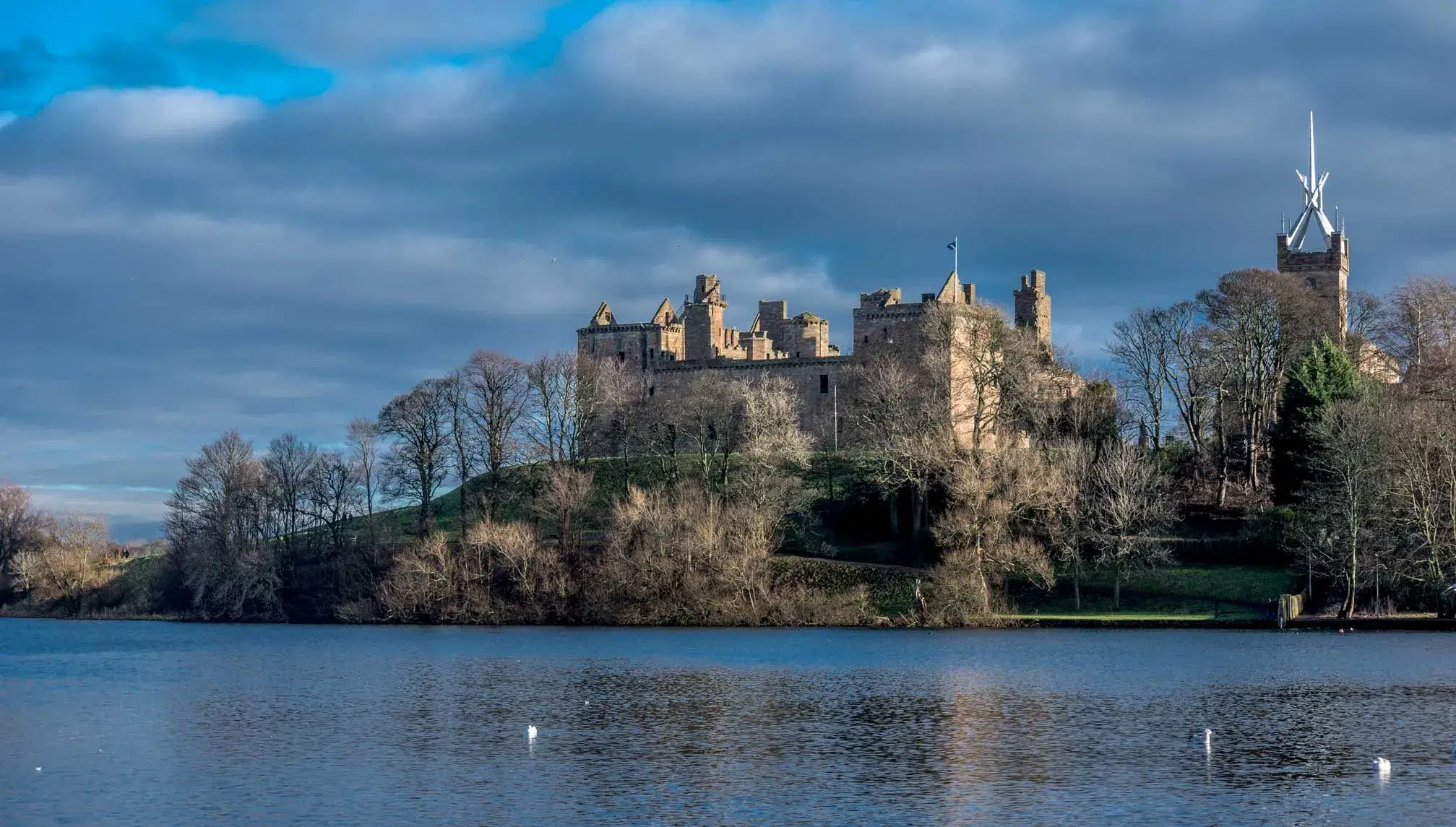
Pass the magnificent ruins of Linlithgow Palace — birthplace of Mary Queen of Scots in December 1542, favourite residence of the Stewart monarchs for two centuries, and burned accidentally by Cumberland’s troops on their way north to Culloden in 1746. This vast Renaissance palace above its own loch is one of the most important and atmospheric royal ruins in Scotland — the full story of the dynasty that built it woven into every remaining wall.
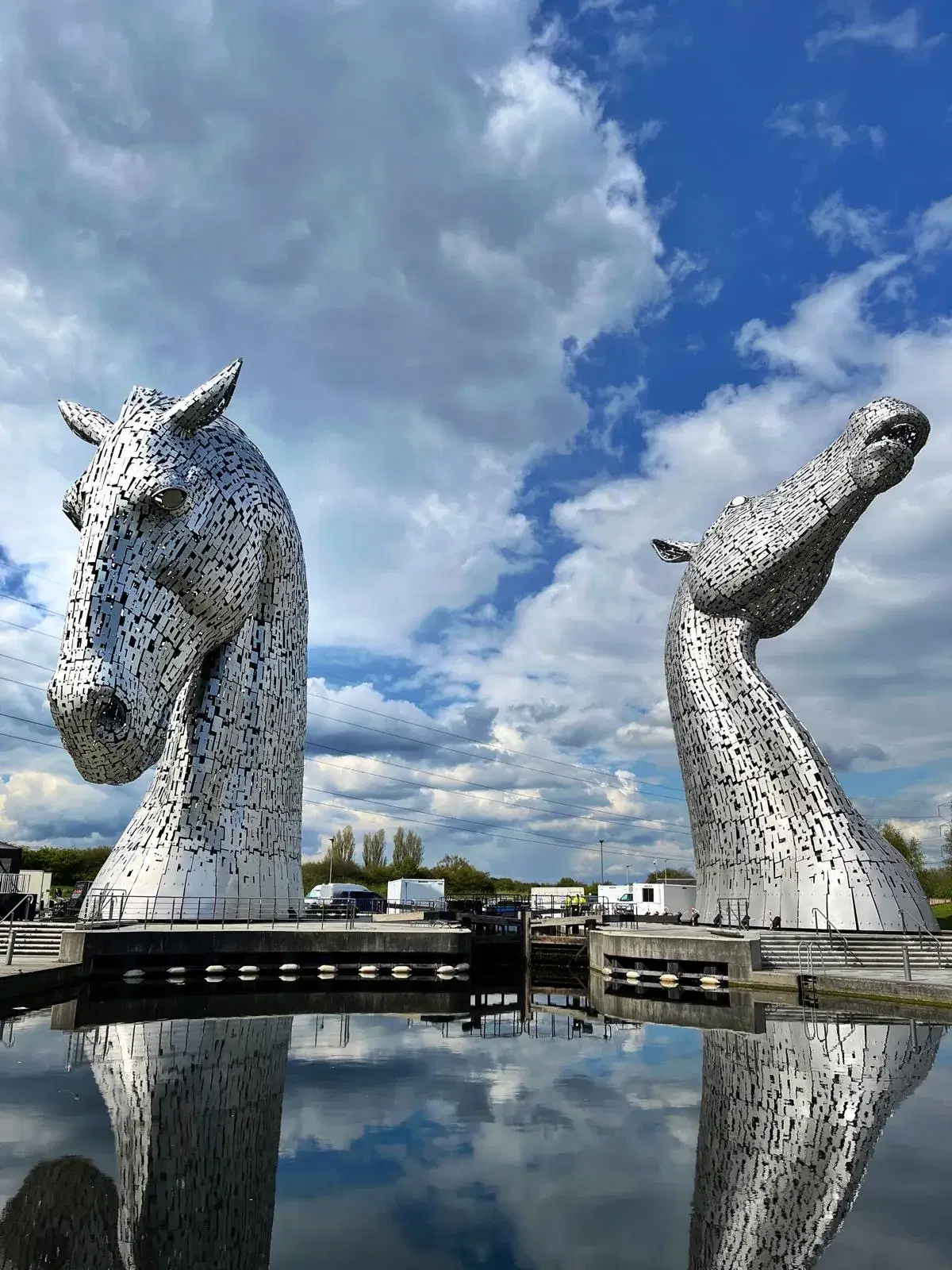
The two 30-metre horse heads of the Kelpies rise above the Forth and Clyde Canal near Falkirk — Andy Scott’s monumental celebration of Scotland’s horse-powered industrial heritage and the mythological kelpie of Highland folklore: the shape-shifting water horse said to haunt the rivers and lochs of the Highlands, luring the unwary to a watery end. At 300 tonnes of steel each, the largest equine sculptures in the world.
Arrive in Stirling and ascend to the castle that controlled Scotland’s destiny — perched on its volcanic rock at the strategic fulcrum of the country, this is, in Johnny’s considered opinion, the finest castle visit in Scotland. The Renaissance Royal Palace built by James V in the 1540s, the Great Hall with its magnificent hammerbeam roof, the recreated Stirling Heads tapestries, and views from the battlements across seven historic battlefields make the experience extraordinary. The nearby Wallace Monument rises above the Carse of Stirling, housing the original two-handed broadsword of William Wallace — a weapon of such scale it prompts genuine astonishment.
Enter the National Park and stop in the perfect village of Luss on the western shore of Loch Lomond — Scotland’s largest freshwater loch at 39 kilometres long. Immaculate stone cottages, flower-filled gardens, and sweeping views across to Ben Lomond make it one of the most photographed and painted villages in Scotland. The famous song ‘The Bonnie Banks o’ Loch Lomond’ was said to have been composed by a Jacobite prisoner in Carlisle — the ‘low road’ the spirit road along which the souls of the dead travel home to Scotland.
Climb through the Arrochar Alps to the summit of the Rest and Be Thankful — named for the relief of soldiers who built the military road over it in the 18th century — and descend into Argyll. Inveraray Castle, home to the Dukes of Argyll and Chiefs of Clan Campbell for centuries, offers the extraordinary Armoury Hall, lavish State Rooms arranged for Queen Victoria’s visit of 1877, and the Downton Abbey and Outlander filming connections.
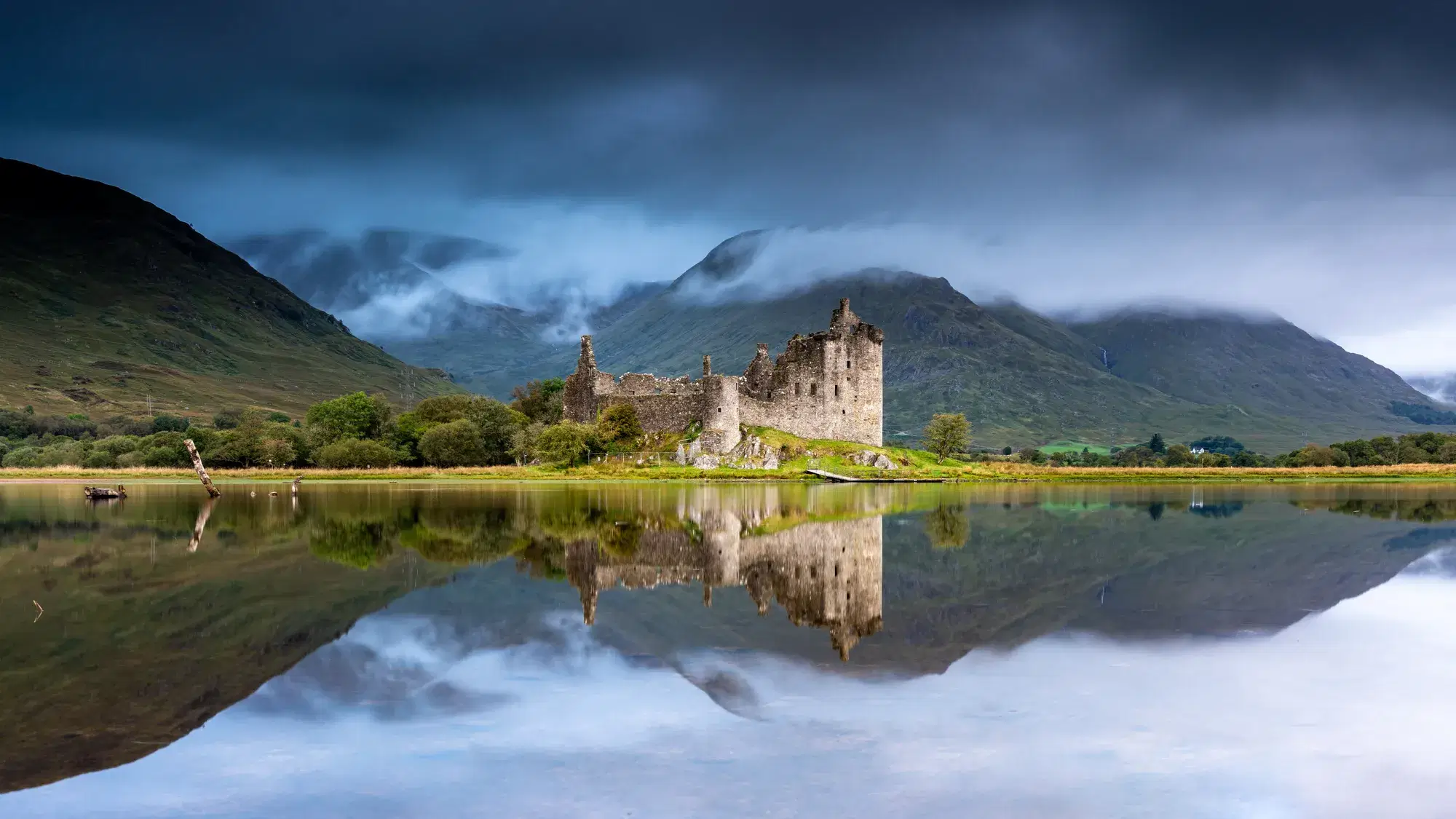
🏰 Kilchurn Castle – The Jewel of Loch Awe
Travel north to Loch Awe and Kilchurn Castle — a 15th-century Campbell fortress rising from a rocky promontory at the head of the loch, its perfect reflection in the still dark water framed by the soaring peaks of Ben Cruachan. One of the most romantically ruined and most photographed castles in Scotland — a place that silences even the most seasoned Highland traveller.
🦞 Oban – Scotland’s Seafood Capital
Arrive in Oban as the evening settles over the harbour — the gateway to the Hebridean Islands, where the Seafood Hut on the pier serves langoustines and scallops caught that same day, and McCaig’s Victorian folly crowns the hill above the bay. Dine superbly, rest well, and prepare for the drama of Day Two — because tomorrow, the Highlands begin in earnest.
Approximately 9 hours | Oban to Skye via Glencoe, Fort William & Mallaig | Overnight: Isle of Skye (Night 2)
Depart Oban and head north into the full drama of the western Highlands — through the massacre glen, beneath Britain’s highest mountain, along the most beautiful stretch of road in Scotland, and across the sea to the island that awaits. Every mile of Day Two builds on the last, until Skye appears across the Sound of Sleat and the adventure moves to an entirely new dimension.
Enter Glencoe — where the mountains close in on every side and the valley carries the weight of the 1692 Massacre, one of the most infamous acts of treachery in Highland history. Government soldiers of Clan Campbell, having accepted twelve days of MacDonald hospitality, rose at dawn to murder 38 sleeping hosts on government orders. The rest fled into a blizzard. Johnny tells the full story here, in the place where it happened — and the mountains listen.
Continue to Fort William at the foot of Ben Nevis — Britain’s highest mountain at 1,345 metres, the Outdoor Capital of the UK. Whether the summit is clear or cloud-capped, the sheer scale of the mountain rising above Glen Nevis is genuinely humbling — one of those experiences that permanently recalibrates your understanding of the word ‘mountain’.
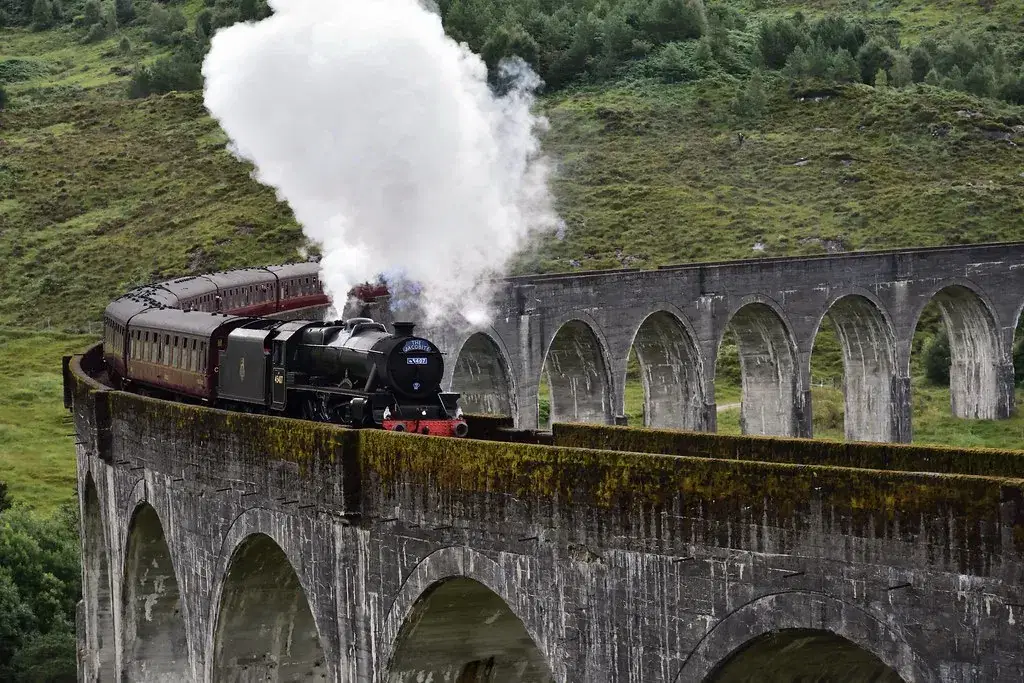
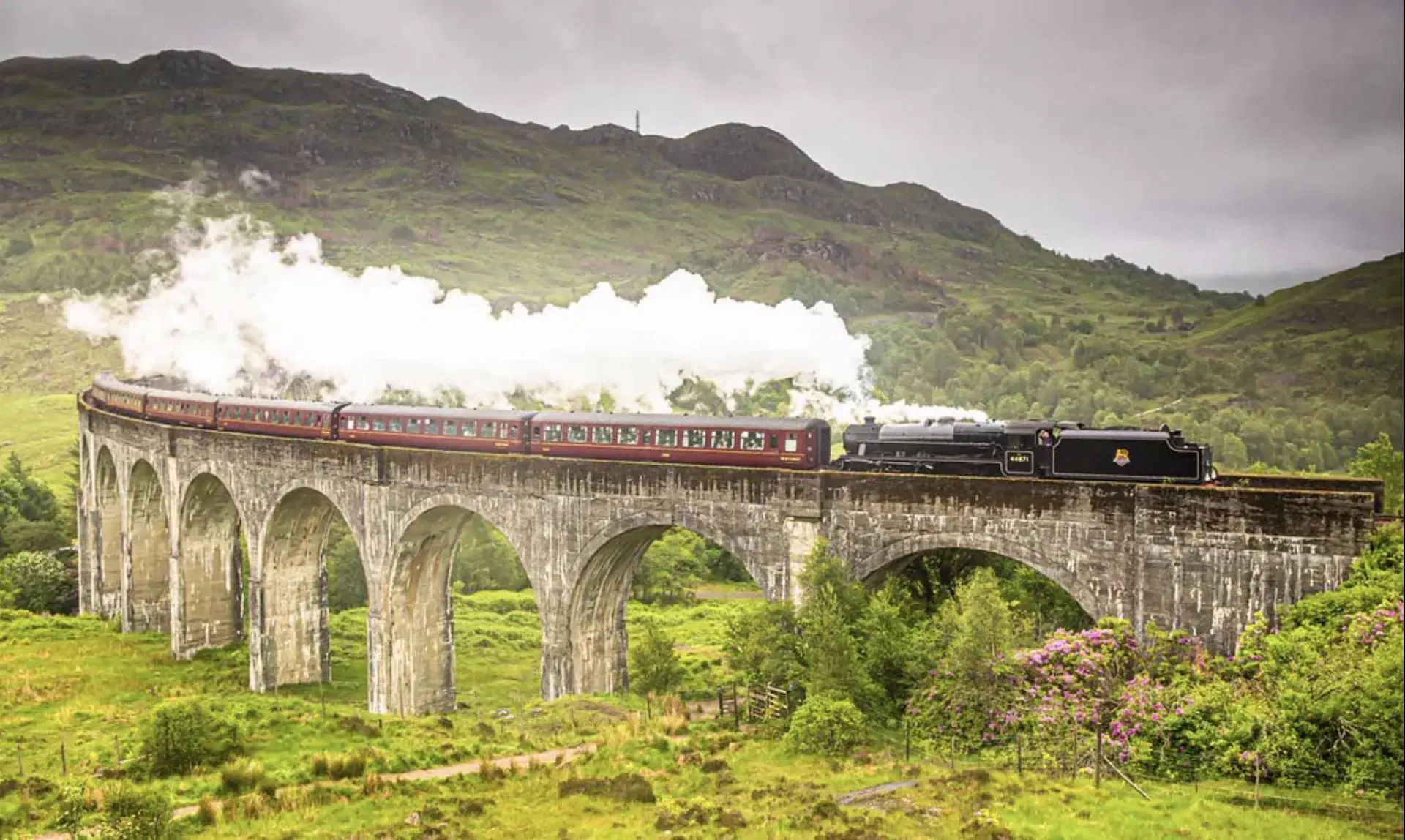
At Fort William, one of Scottish touring’s most delightful decisions awaits. Board the Jacobite Steam Train — the iconic heritage railway crossing the 21-arch Glenfinnan Viaduct that inspired J.K. Rowling’s Hogwarts Express — for a journey of pure cinematic magic to Mallaig. Or travel the Road to the Isles by private vehicle, stopping at the Glenfinnan Monument on the shores of Loch Shiel — where Bonnie Prince Charlie raised his standard on 19 August 1745, beginning the last Jacobite Rising. Either choice delivers the Glenfinnan Valley: one of the most beautiful and historically charged places in Scotland.
Board the CalMac ferry at Mallaig for the crossing to Armadale on the Sleat Peninsula — a passage of extraordinary beauty across the Sound of Sleat. Bottlenose and common dolphins regularly ride the bow wave; porpoises, seals, and minke whales are far from rare. Keep your eyes on the water as Skye draws closer.
Drive north through Skye’s dramatic interior past the extraordinary black peaks of the Cuillin Mountains — the most technically challenging ridge in the British Isles — and arrive in Portree, Skye’s colourful harbour capital. Two full days of island exploration begin tomorrow.
Full day on Skye | Overnight: Isle of Skye (Night 3)
Two nights on Skye means Day Three belongs entirely to the island — no ferry to catch, no miles to cover beyond the island itself. The Isle of Skye rewards those who give it proper time: its jagged mountain peaks, sea cliffs, ancient brochs, fairy pools, and Atlantic coastline are a landscape that changes character with every hour of light and every shift of weather. Today is that time.
Begin at Dunvegan Castle — the oldest continuously inhabited castle in Scotland, home to the Chiefs of Clan MacLeod for over 800 years without interruption. Explore the richly furnished State Rooms, discover the legendary Fairy Flag — said to have been gifted by the fairies and capable of saving the clan from defeat in battle — and wander the beautiful woodland gardens above the dark waters of Loch Dunvegan.
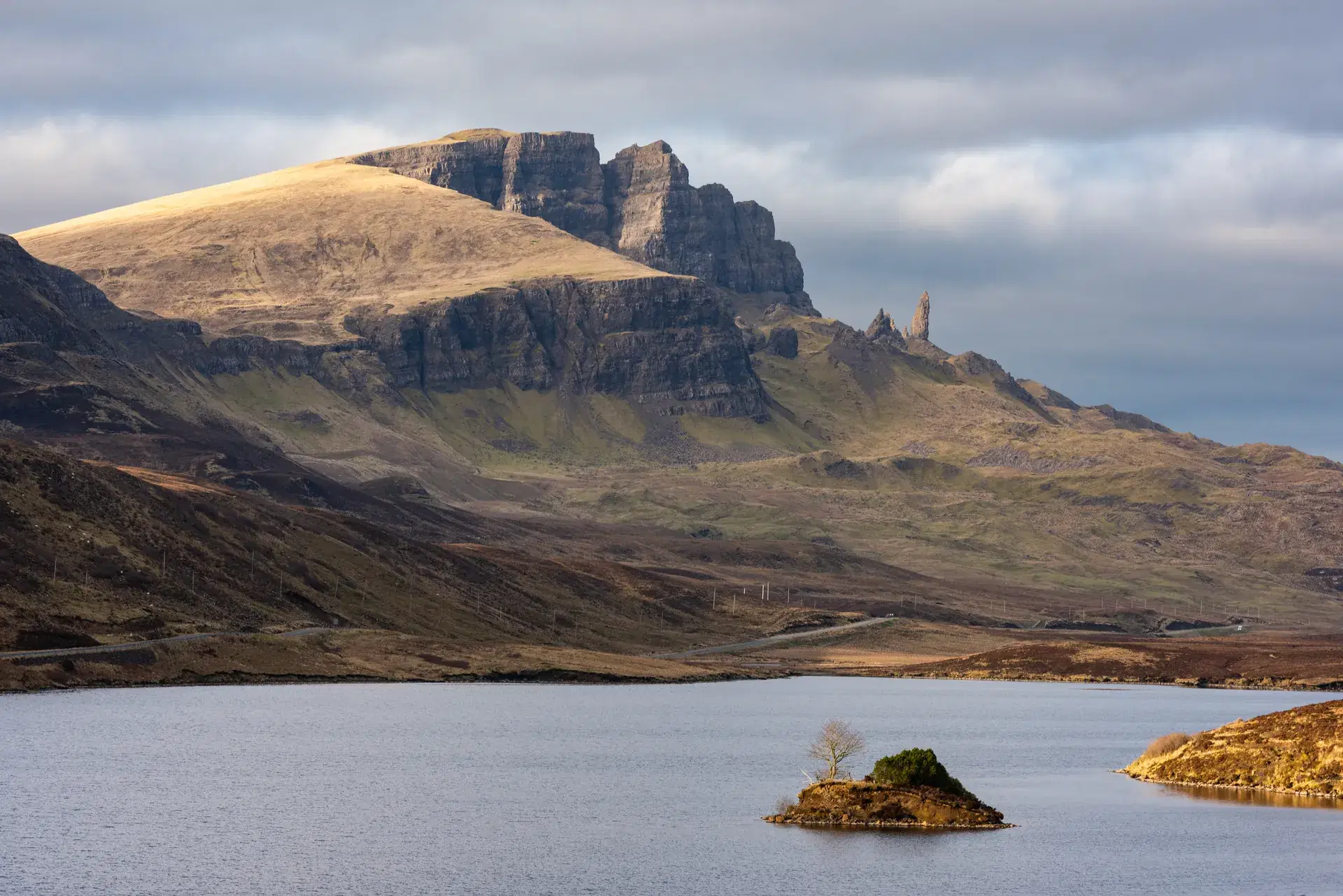
Travel north along the Trotternish Peninsula — the longest continuous landslip in the UK — to the Old Man of Storr: a 50-metre pinnacle of black basalt rising impossibly above Loch Leathan, first climbed in 1955, steeped in the legend of a giant buried in the hillside below. In mist the pinnacle appears and dissolves from the clouds in a way that perfectly earns Skye its Gaelic name: Eilean a’ Cheò, the Misty Isle.
Continue to Kilt Rock — the towering basalt sea cliff whose vertical striations resemble the pleated folds of a Highland kilt — where Mealt Falls plunge 55 metres directly from the clifftop into the sea below. On clear days the view extends toward the Outer Hebrides — a reminder of just how close to the edge of Europe you are standing.
Travel west to Neist Point — the most westerly tip of Skye, where sheer cliffs drop into the Atlantic, a white lighthouse marks the land’s end, and the open sea stretches toward the Outer Hebrides and beyond. The Vikings navigated these waters over a thousand years ago. On calm days the sea is impossibly blue; in a westerly gale it is a demonstration of raw oceanic power that is utterly unforgettable.
Stop at Sligachan Bridge — where the old stone crossing frames a classic view of the Black Cuillin filling the entire northern horizon, one of the most iconic Highland panoramas in Scotland. The Victorian alpinists Norman Collie and John Mackenzie pioneered their first Cuillin ascents from the hotel here. Local legend promises that washing your face in the Sligachan burn will grant eternal beauty.
For whisky lovers, Talisker Distillery at Carbost — Skye’s only single malt, shaped by sea salt, coastal peat, and over 190 years of island tradition — is one of the finest distillery experiences in Scotland. Robert Louis Stevenson called it ‘the king o’ drinks’. The afternoon and evening remain yours: the Fairy Pools, a wildlife cruise from Portree for sea eagles and seals, a long walk on a white sand beach, or simply the extraordinary quality of Skye’s light at dusk over the Cuillins.
Approximately 9 hours | Skye to Inverness via Eilean Donan & Loch Ness | Overnight: Inverness (Night 4)
Depart Skye via the bridge and travel through some of the most powerful and atmospheric landscapes in Scotland — past the most photographed castle in the country, through the ancient fault of the Great Glen, and along the legendary dark shores of Loch Ness to the vibrant capital of the Highlands. Day Four moves from island beauty into Highland history and legend.
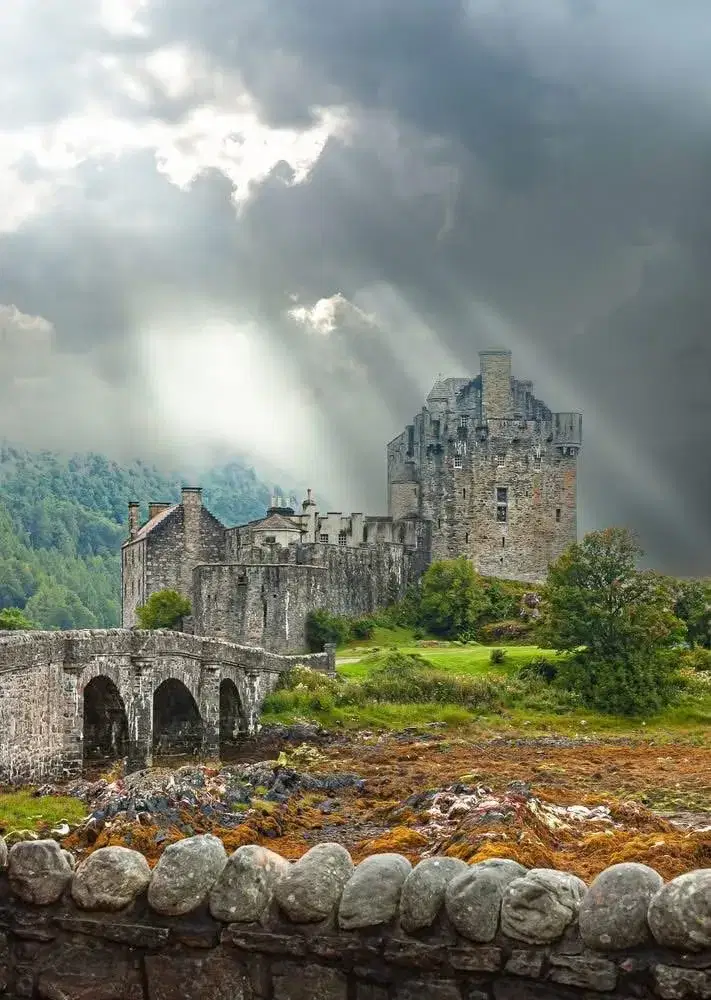
Cross the Skye Bridge and travel to Eilean Donan — rising from its tiny tidal island at the meeting point of three sea lochs with the mountains of Kintail behind it. Destroyed in 1719 when a Spanish Jacobite garrison was shelled by Royal Navy frigates, restored between 1919 and 1932, Eilean Donan is the most instantly recognisable castle in Scotland — its atmospheric rooms, Jacobite artefacts, and the view from the bridge across the still water among the most memorable in Highland touring.
Travel north through Glen Moriston into the Great Glen — the vast natural fault line cutting Scotland diagonally from Fort William to Inverness, its chain of freshwater lochs connected by Thomas Telford’s Caledonian Canal, completed in 1822. This primordial rift has served as the primary route through the central Highlands for millennia — used by Pictish tribes, Viking raiders, medieval armies, and drovers moving cattle south to market.
Reach the shore of Loch Ness — 37 kilometres of the deepest, darkest, and most legendary loch in Scotland, holding more fresh water than all the lakes of England and Wales combined, plunging to 230 metres at its deepest. Stop at Fort Augustus, where Telford’s staircase of five canal locks connects the Caledonian Canal to the loch — a perfect lunch stop with the dark water stretching away to the north. The Nessie legend stretches back to 565 AD; no subsequent investigation has managed to extinguish it.
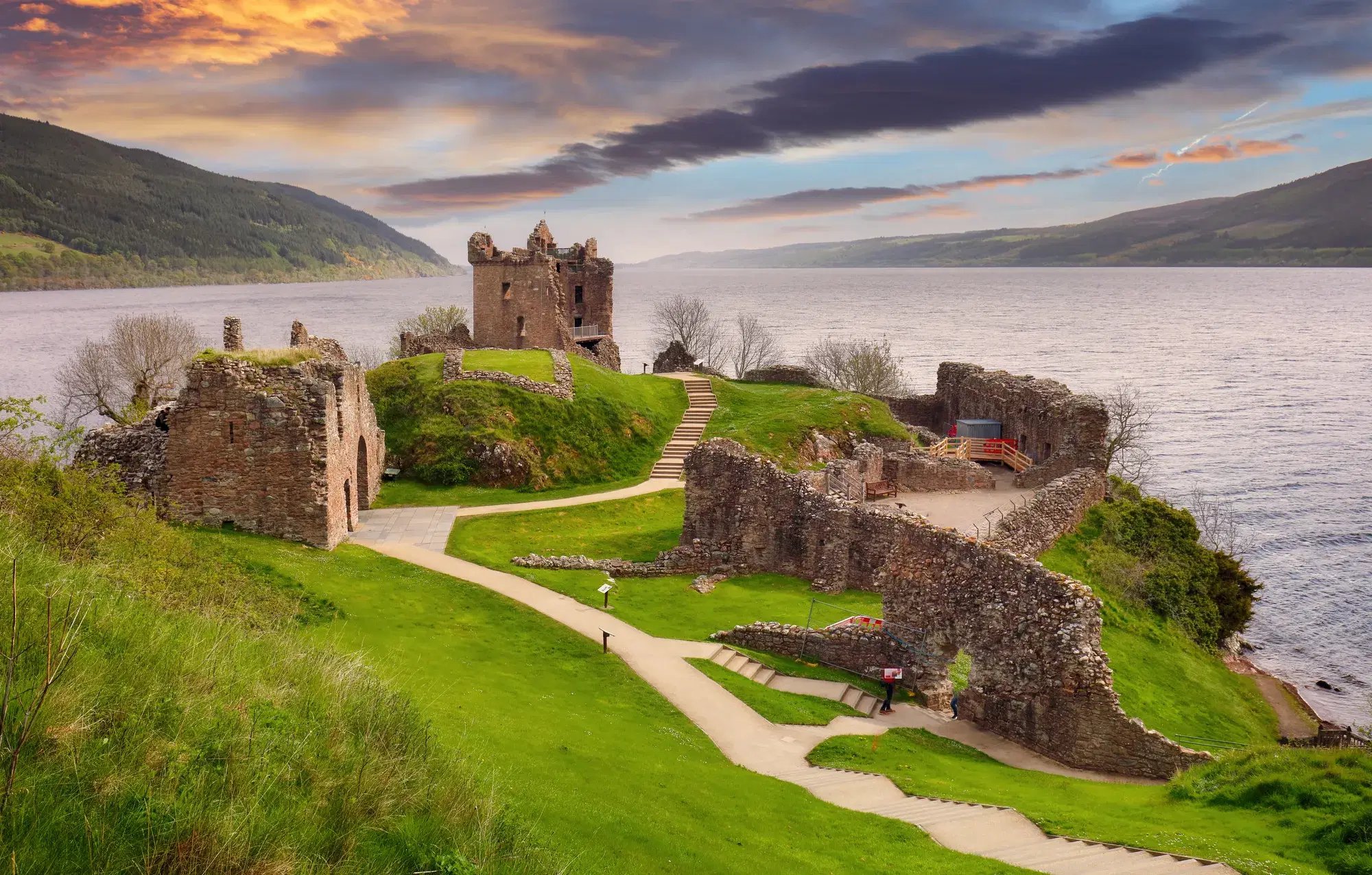
Stop at Urquhart Castle — dramatic medieval ruins on a rocky headland above Loch Ness, blown up by its own garrison in 1692 to prevent Jacobite occupation. The finest view across the loch in either direction, and an optional 30-minute cruise arriving by water — giving a perspective on the castle and the loch’s extraordinary scale that the road cannot provide.
Arrive in Inverness for your fourth overnight — the city of genuine warmth and Highland pride where the River Ness meets the Beauly Firth. Explore the Victorian riverside, dine superbly, and rest well. Tomorrow brings Culloden, Clava Cairns, the Highland Folk Museum, and the whisky glens of Speyside.
Approximately 9 hours | Inverness south via Cairngorms & Speyside to Pitlochry | Overnight: Pitlochry (Night 5)
Day Five is the tour’s richest historical and sensory chapter — beginning on the most emotionally powerful battlefield in Britain, moving through a 4,000-year-old prehistoric site, stepping inside a living Highland township frozen in time, traversing the magnificent Cairngorms, and ending among the world’s greatest whisky distilleries. From ancient cairns to copper pot stills — Scotland’s full timeline in a single extraordinary day.
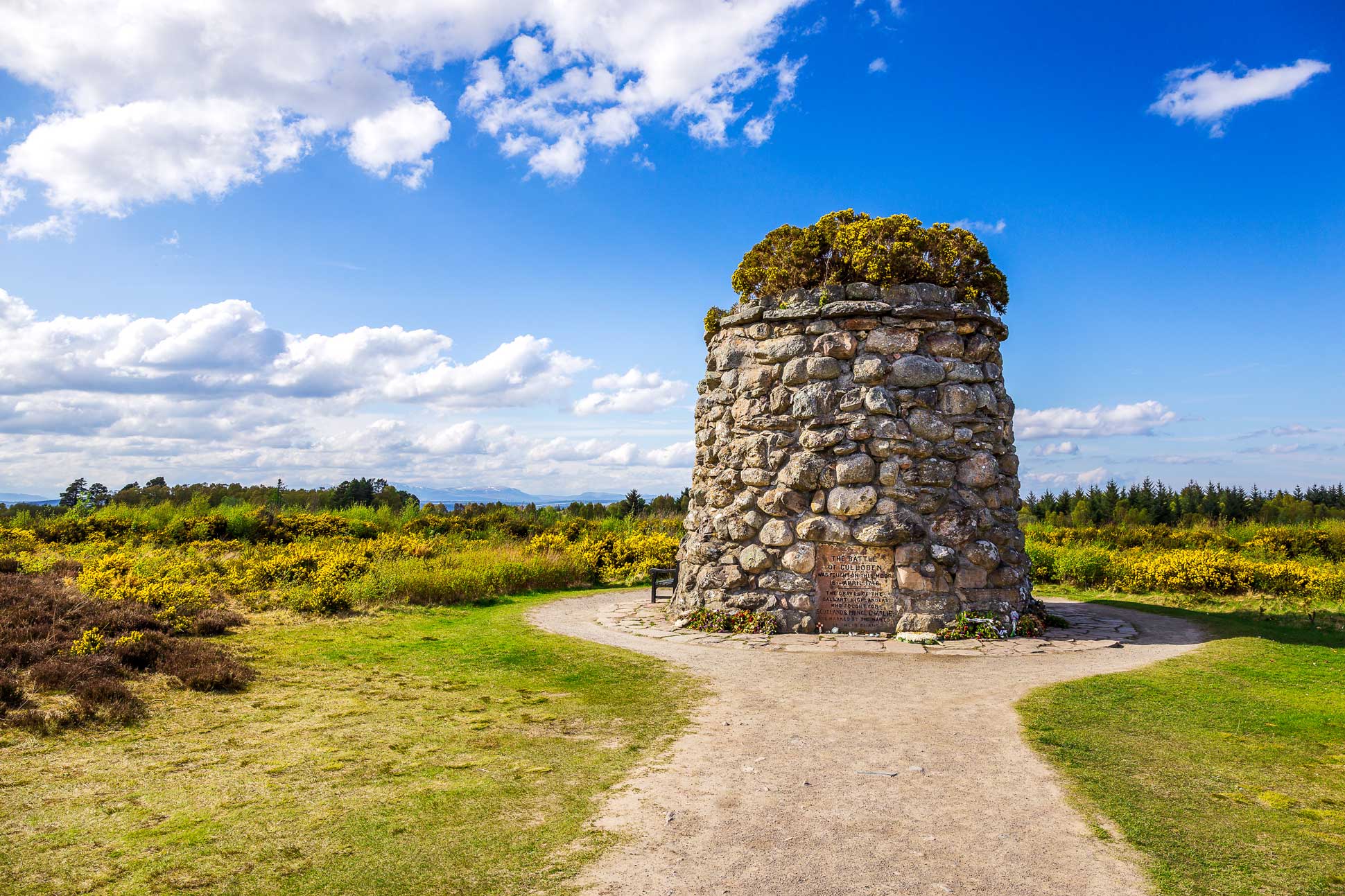
Drive east from Inverness to Culloden Moor — where on 16 April 1746 the last pitched battle ever fought on British soil was decided in under sixty minutes. The Jacobite army of Bonnie Prince Charlie was shattered by Cumberland’s government forces in a defeat that ended the Jacobite cause, destroyed the Highland clan system, and set in motion the Clearances that emptied the glens of their people. Walk among the clan grave markers and visit the outstanding National Trust for Scotland visitor centre. Few places in Britain carry such palpable, quiet grief.
A short drive brings you to Clava Cairns — Bronze Age passage graves and standing stone circles dating from around 2000 BC, positioned with extraordinary astronomical precision: the largest cairn aligned so that the midwinter sun shines through its entrance passage to illuminate the chamber within. Outlander fans will recognise Clava Cairns as the direct inspiration for the standing stone circle through which Claire Randall passes into the 18th century in the opening episode of the series.
Travel south through the Cairngorm National Park — the largest in the UK at 4,528 square kilometres of ancient mountain plateau, Caledonian pine forest, and sweeping Highland river valleys. Pass Aviemore and along the broad valley of Strathspey, the high Cairngorm plateau — home to reindeer, snow buntings, and Britain’s only Arctic mountain ecosystem — stretching away to the east.
Stop at the Highland Folk Museum at Newtonmore — one of the most immersive and extraordinary heritage experiences in Scotland, and one that most visitors to the Highlands never discover. This open-air museum recreates a complete Highland township across 80 acres, bringing together reconstructed buildings spanning four centuries of Highland life — from a 1700s turf-walled blackhouse township and a Victorian schoolhouse to a 1950s working farm. Costumed interpreters bring each era to life with demonstrations of traditional crafts, cooking, and daily routines that paint a vivid and deeply moving picture of how ordinary Highland people lived, worked, loved, and endured. This is the human story of the Highlands — and it is one of the most affecting stops on the entire nine days.
Descend into Speyside — the sheltered valley of the River Spey that produces more single malt Scotch whisky than any other region on earth. Johnny will guide you to one or two of the valley’s extraordinary producers. Strathisla at Keith — the oldest licensed distillery in the Highlands, the spiritual home of Chivas Regal, its twin pagoda roofs and stone buildings among the most beautiful distillery architecture in Scotland. Cardhu — where Helen Cumming quietly sold whisky to passing drovers from her Speyside farmhouse in the 1820s while her husband signalled approaching excise men with a flag from the roof. These are stories as compelling as the whisky itself.
Arrive in Pitlochry for your fifth overnight — the charming Victorian spa town set amid the wooded gorges and fast rivers of Highland Perthshire. Dine well, explore the town’s independent shops and pubs, and consider an evening visit to Edradour — Scotland’s smallest traditional distillery, just minutes from the town centre. Tomorrow, the road stays in Perthshire for an extraordinary day of royal history.
Full day in Perthshire | Based from Pitlochry | Overnight: Pitlochry (Night 6)
Day Six stays in Perthshire — and with a second night in Pitlochry already secured, there is no rush, no distance to cover, and no compromises to make. This is a full, unhurried day in Scotland’s most royally saturated landscape: the coronation grounds of a thousand years of Scottish kings, the grandest privately occupied castle in Scotland, and one of the most beloved viewpoints in the entire country. Royal Perthshire at its finest.
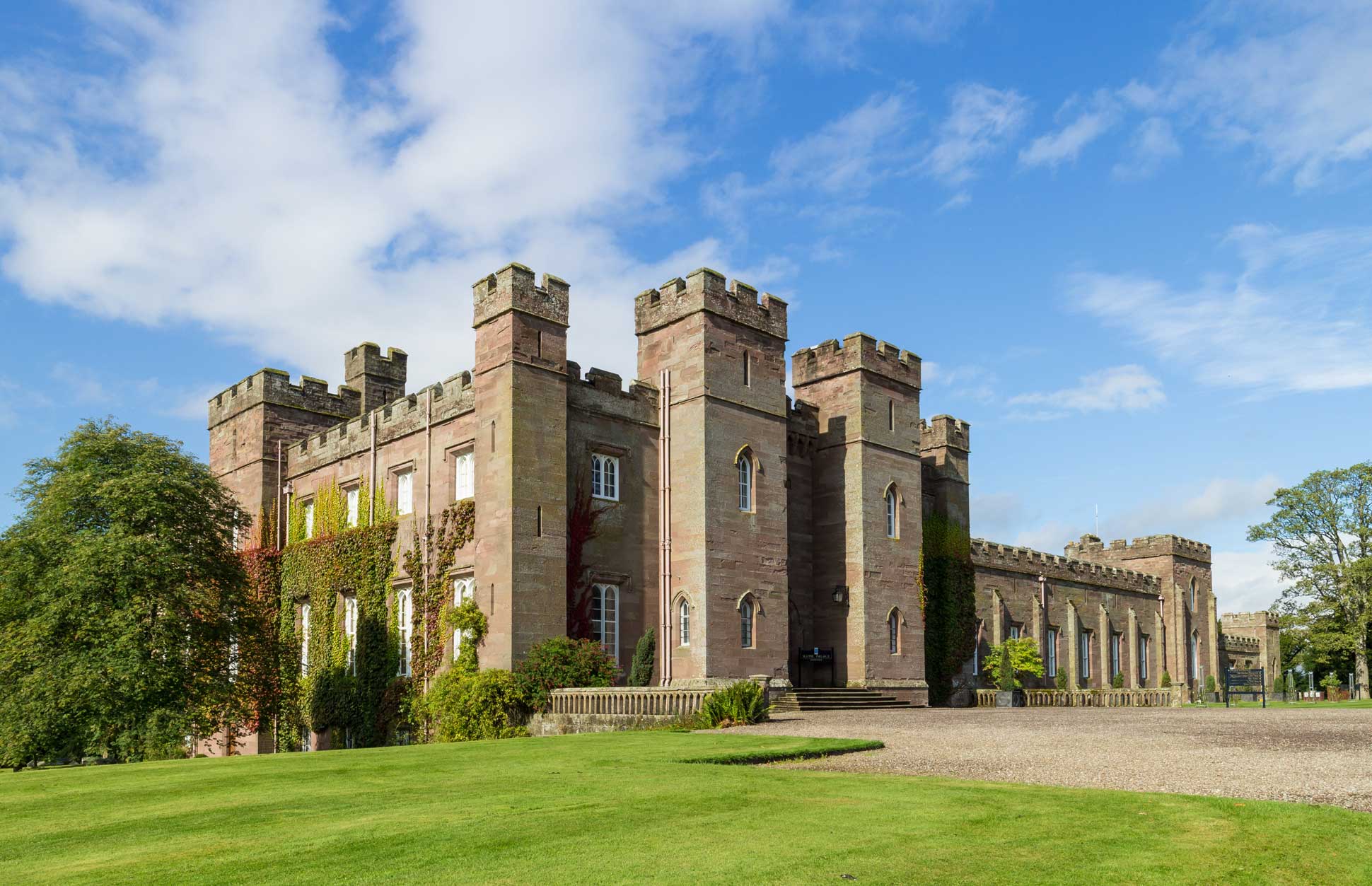
Begin at Scone Palace — built on the site where every King of Scotland from Kenneth MacAlpin to John Balliol was crowned for nearly a thousand years, seated upon the legendary Stone of Destiny. Among those crowned here: Macbeth — the real Macbeth, King of Scotland from 1040 to 1057, far more capable and complex than Shakespeare’s portrait — and Robert the Bruce, whose 1306 coronation began Scotland’s greatest struggle for independence. The Stone was seized by Edward I in 1296, held at Westminster for seven centuries, and returned to Scotland in 1996. The current Gothic Revival palace is the family home of the Earls of Mansfield and houses a remarkable collection of porcelain, furniture, and artworks accumulated over four centuries.
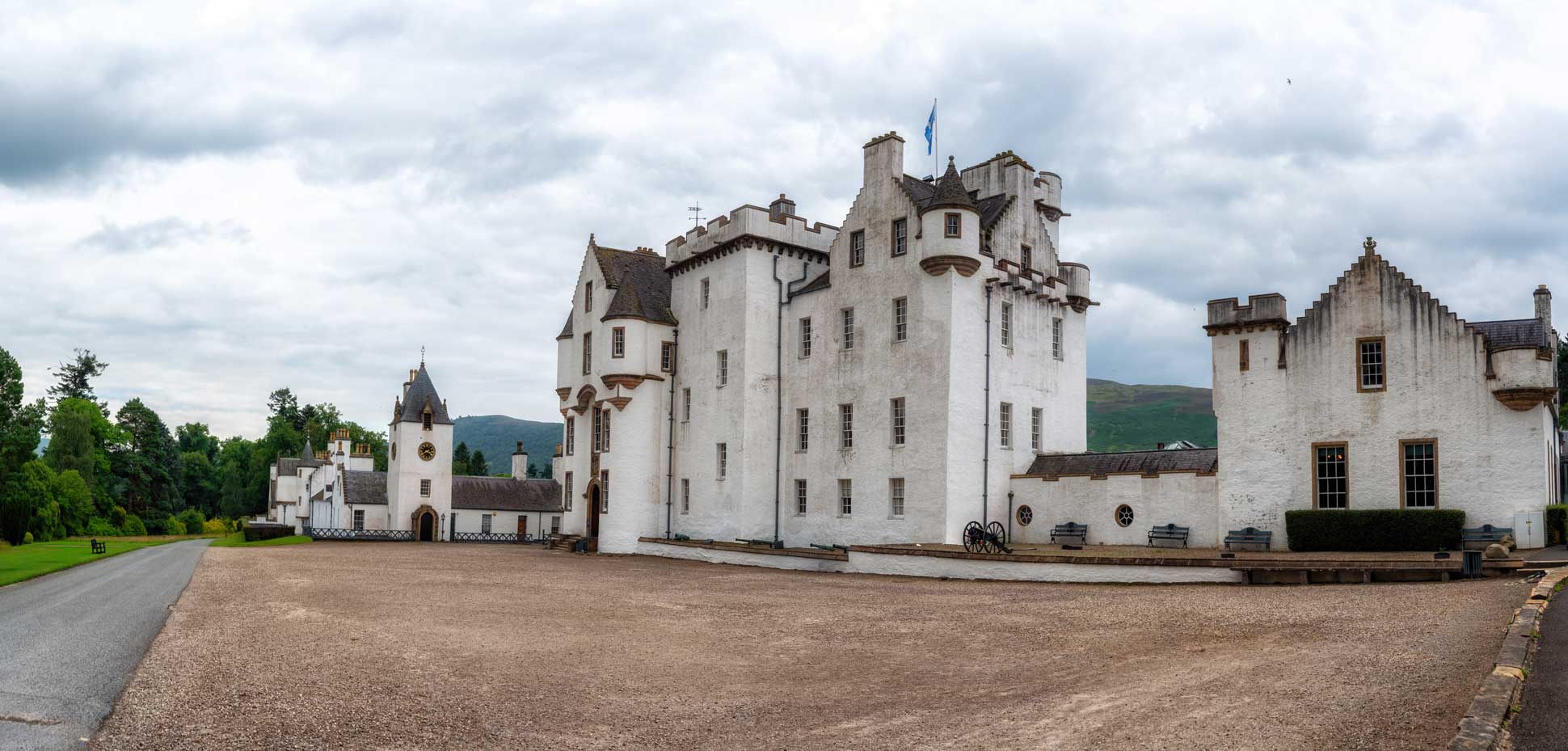
Travel north to Blair Castle — one of the most impressive and best-loved castles in Scotland, the ancestral seat of Clan Murray and the family home of the Dukes of Atholl for over 700 years. This gleaming white turreted fortress rises from the wooded floor of the Tay valley with the Grampian Mountains towering behind it — one of Scotland’s most photographed and recognisable landmarks. Explore 30 remarkable rooms spanning seven centuries of Scottish history, from the medieval great hall to the Victorian state rooms crammed with Jacobite relics, weapons, porcelain, and portraits.
The Duke of Atholl holds the unique and extraordinary distinction of being the only British subject permitted to maintain a private army — the Atholl Highlanders — a privilege granted by Queen Victoria in 1844 and still honoured to this day. This is one of those details that makes a place completely and permanently unforgettable.
Stop at the House of Bruar — Scotland’s most celebrated country store, set beneath the dramatic Falls of Bruar in the heart of Atholl. This remarkable emporium sells the finest Scottish tweed, cashmere, country clothing, locally produced food and drink, and gifts of genuine quality. An excellent lunch stop and the ideal place to browse — and perhaps carry a little piece of Scotland home.
The day reaches its visual and emotional peak at The Queen’s View — the breathtaking panorama across Loch Tummel to the perfectly conical peak of Schiehallion, the ‘Fairy Hill of the Caledonians’, rising to 1,083 metres. Named for Queen Victoria, who was captivated by this prospect during her 1866 visit, the viewpoint is one of Scotland’s most beloved and photographed — and with reason. Schiehallion has an extraordinary scientific distinction: in 1774, the astronomer Nevil Maskelyne used the mountain’s near-perfect conical shape to estimate the mass of the Earth — the first time humanity had calculated our planet’s weight. Stand here and consider that this serene Scottish mountain helped unlock one of science’s greatest secrets.
Return to Pitlochry for your second evening in the town — perhaps exploring Edradour Distillery, attending a performance at the Pitlochry Festival Theatre above the River Tummel, or simply walking the gorge of the Pass of Killiecrankie as the Highland light fades. Tomorrow, the road turns east into Royal Deeside.
Approximately 10 hours | Pitlochry east via Deeside to Dunnottar | Overnight: Edinburgh or Perthshire (Night 7)
Day Seven turns east from Perthshire across the high Cairngorm passes into Royal Deeside — the valley of the River Dee that has been the summer sanctuary of the British Royal Family for nearly two centuries — before reaching the dramatic Aberdeenshire coast and one of the most breathtaking castle sites in Europe. A day of royal grandeur, Highland whisky, and sheer clifftop drama.
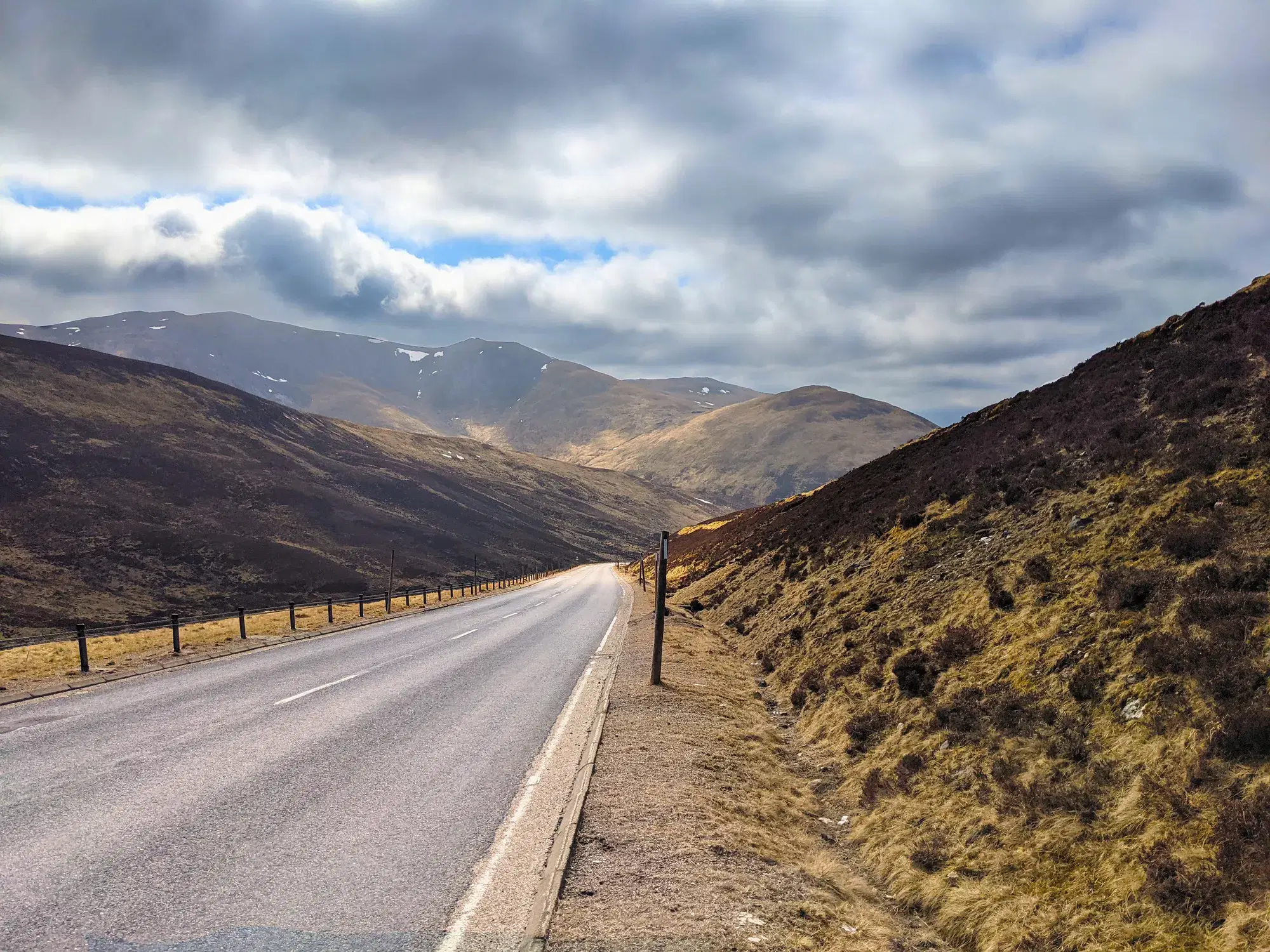
Depart Pitlochry and cross the Pass of Glenshee — the A93 climbing to 665 metres, the highest main road in the United Kingdom — through sweeping mountain moorland and vast Highland sky. This is the gateway to Royal Deeside, and it announces the valley below with entirely appropriate grandeur.
Descend into Braemar — the highest village in the British Isles to have a post office, home of the Braemar Gathering, the most famous Highland Games in the world. Attended each September by the British Royal Family in a tradition stretching back to the 11th century — caber tossing, hammer throwing, Highland dancing, and piping competitions, presided over by the monarch in person.
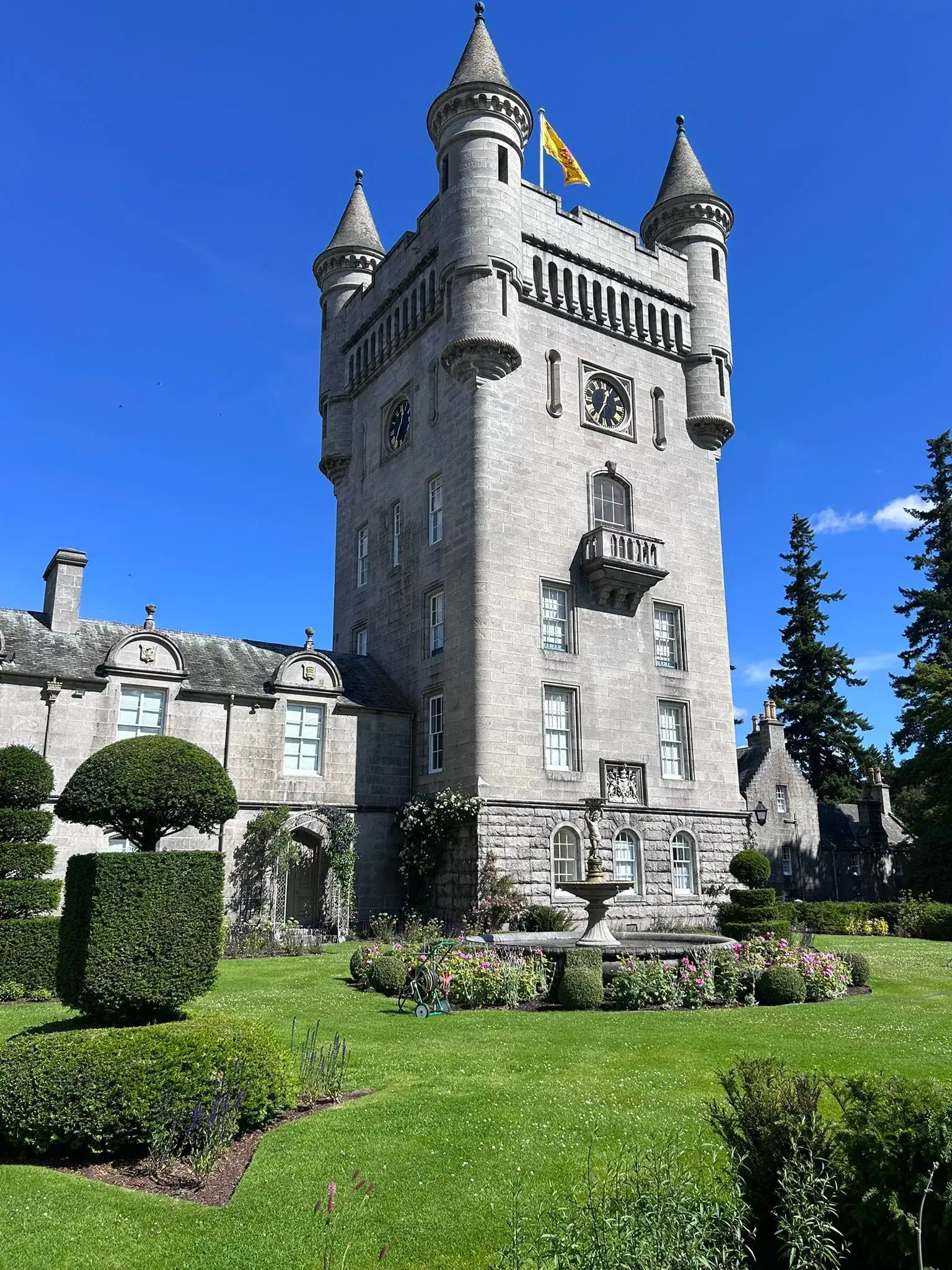
Travel east along the River Dee through immaculate granite villages steeped in the atmosphere of a valley that royalty has made its own. Crathie Kirk — where the Royal Family worships when in residence — is open to visitors, its memorials to the Royal Household stretching back to the Victorian era. Balmoral Castle — purchased by Prince Albert in 1852 as a private retreat for Queen Victoria, who described Deeside as ‘this dear paradise’ — remains the personal property of the monarch and is open when the Royal Family is not in residence. Continue through Ballater — whose shops still bear the Royal Warrant — and Banchory, where the Dee runs fast over famous salmon pools.
On the slopes of Lochnagar above Balmoral sits Royal Lochnagar Distillery — founded in 1845 and granted its Royal Warrant just three years later when Queen Victoria and Prince Albert walked up from the castle to visit. One of the very few distilleries ever to hold a Royal Warrant, its small-batch hand-crafted single malt is among the most distinctive and sought-after in the Highlands.
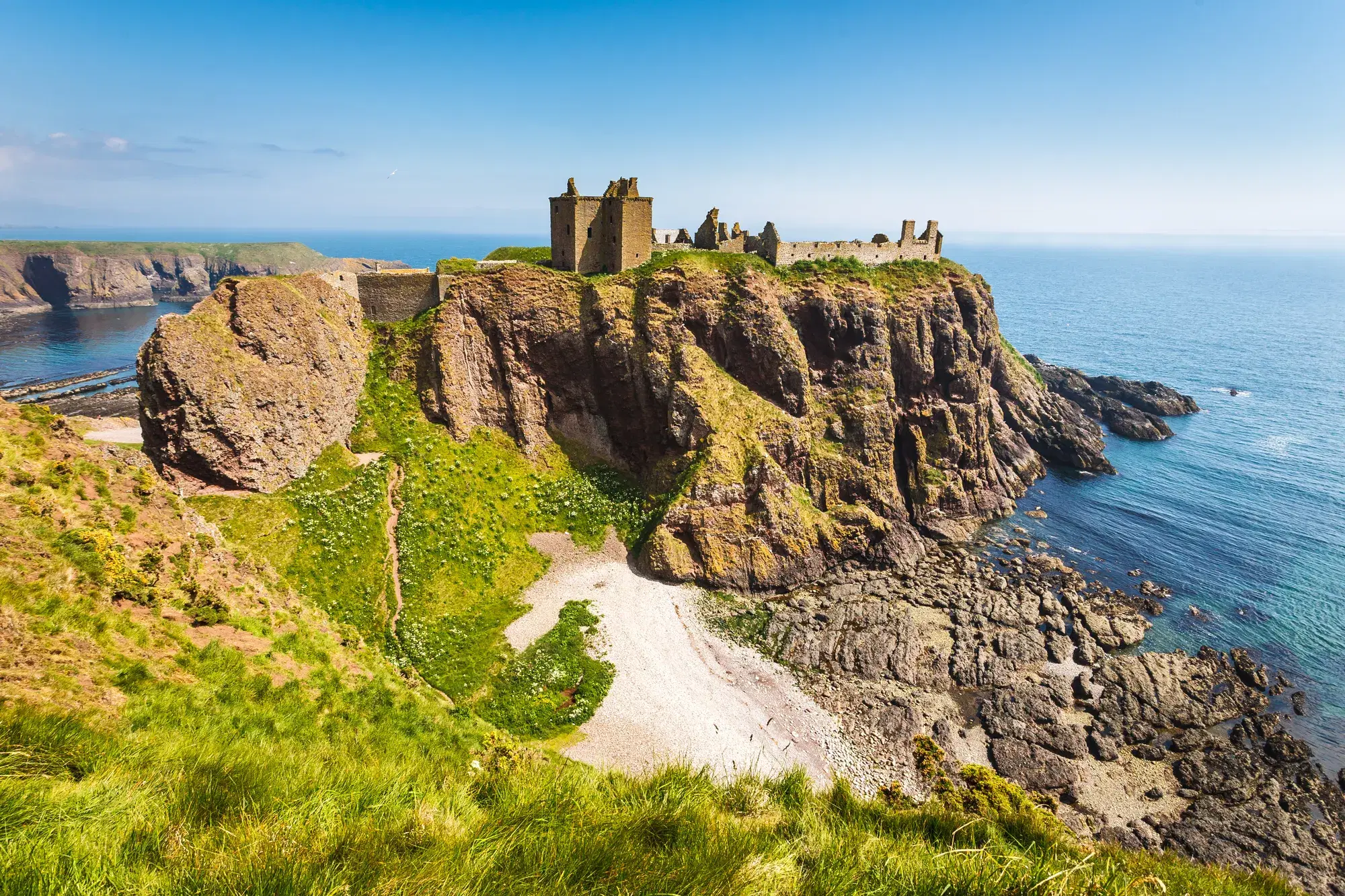
Travel east to the Aberdeenshire coast and Dunnottar Castle — a complete ruined medieval fortress perched on a 160-foot sea stack of volcanic rock, surrounded by the crashing North Sea on three sides, connected to the mainland by a narrow clifftop path. The effect of first seeing Dunnottar from above — a complete fortress rising from the sea as though it grew from the rock — is simply extraordinary.
Dunnottar’s history matches its setting: the Honours of Scotland — the Scottish Crown Jewels — were smuggled out beneath a minister’s wife’s skirts in 1652 to prevent their capture by Cromwell’s besieging army. A garrison of 167 Covenanters was imprisoned in the vaults in 1685 in conditions so horrific the episode became known as the Whigs’ Vault. Mary Queen of Scots visited in 1562. Mel Gibson filmed Hamlet here. Dunnottar earns every superlative given to it.
Travel south through Angus and Perthshire toward your seventh overnight — the extraordinary experiences of Deeside and Dunnottar settling as Scotland’s eastern landscape rolls south toward the lights of Edinburgh or Perthshire.
Approximately 9 hours | Through the Trossachs National Park | Overnight: Stirling or Edinburgh (Night 8)
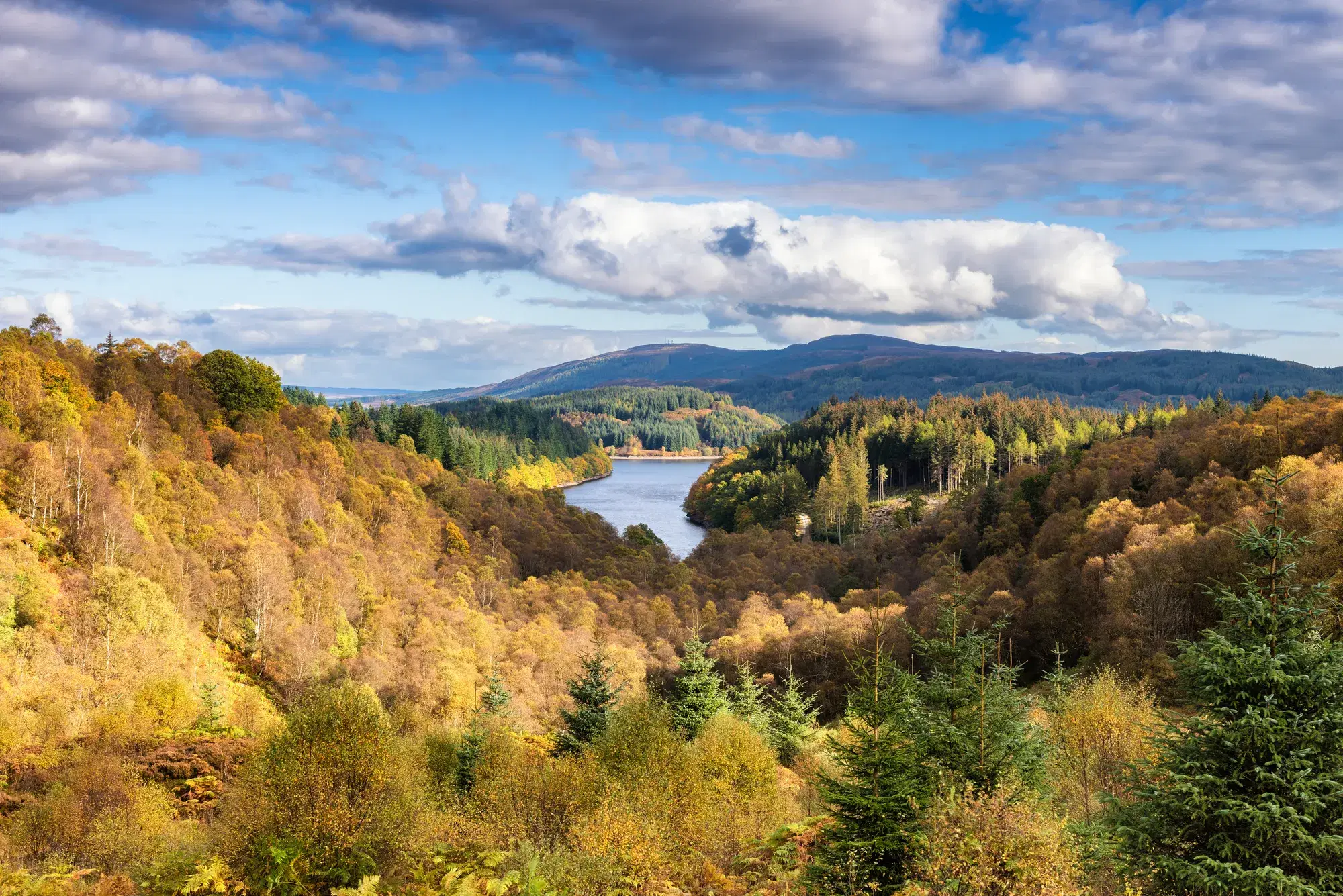
Day Eight is the tour’s most romantic and literary chapter — a full day in the Loch Lomond and Trossachs National Park, tracing the landscapes that Sir Walter Scott immortalised in verse and novel, and that the outlaw-hero Rob Roy MacGregor made his own. Scotland’s first national park, designated in 2002, at its most beautiful, most atmospheric, and most story-rich — ending with a Highland dram as the perfect finale before the final day.
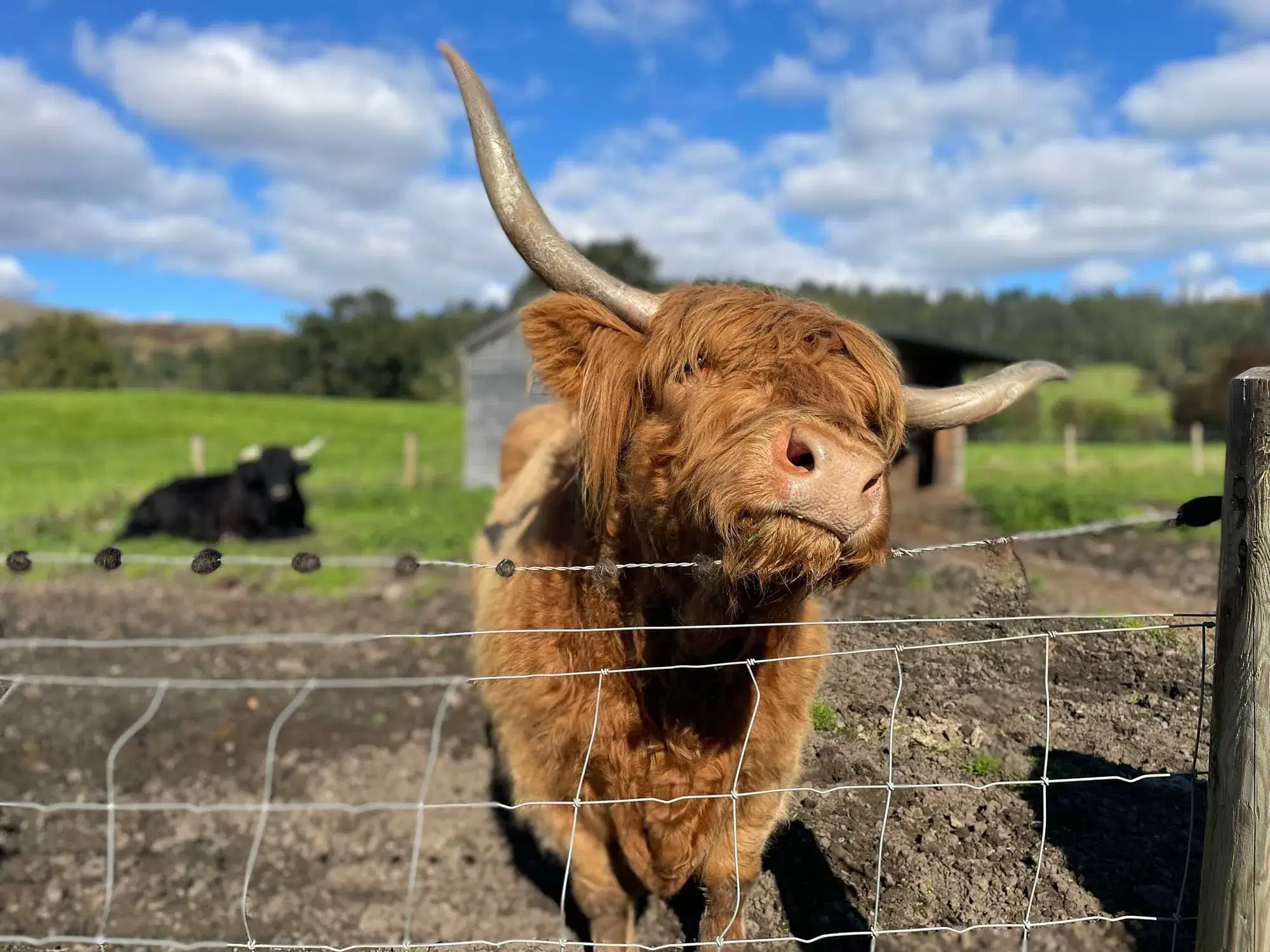
Begin in Callander — the charming gateway town set on the banks of the River Teith at the very edge of the Highland Boundary Fault, the ancient geological line that divides the Scottish Lowlands from the Highlands as sharply as any drawn border. For centuries this was a place of transition — where the ordered landscape of the south gave way to the wilder world of the Highland clans. Browse the independent shops, enjoy a morning coffee, and watch for the Highland cattle that graze the surrounding fields — Scotland’s most irresistible and photogenic residents.
Travel to the Lake of Menteith — the only body of water in Scotland called a ‘lake’ rather than a ‘loch’, the distinction reflecting the Norman French influence of the medieval Earls of Menteith. On a small island at the centre sits Inchmahome Priory — an Augustinian monastery founded in 1238, where Robert the Bruce came three times for solace and counsel, and where the five-year-old Mary Queen of Scots was hidden for three weeks in 1547 to keep her safe from Henry VIII’s advancing English army during the ‘Rough Wooing’. Take the short boat crossing to the island and walk among the beautifully preserved medieval ruins — a place of extraordinary peace and deep historical resonance.
Continue to Aberfoyle — the charming village at the heart of the Trossachs — and ascend the Duke’s Pass: a winding, dramatic road climbing through the Queen Elizabeth Forest Park with views of escalating magnificence over Loch Ard and the surrounding Highland peaks. Built for the Duke of Montrose in the 19th century, the pass delivers a series of breathtaking viewpoints that unfold with every hairpin bend — the kind of road that provokes spontaneous exclamations even from those who thought they were prepared for Scottish scenery.
Descend to the shores of Loch Katrine — the dark, beautiful loch that Sir Walter Scott chose as the setting for ‘The Lady of the Lake’ in 1810, the poem that single-handedly created the Scottish tourist industry and brought the first visitors streaming north from England. Board the Steamship Sir Walter Scott — a 113-year-old steam-powered vessel launched in 1900 and still one of the last working passenger steamships in Scotland — for a cruise along the length of the loch, with commentary on the landscape, the Rob Roy legend, and the extraordinary Victorian engineering project that has supplied Glasgow with drinking water from this loch since 1859.
Travel north to the small, remote glen of Balquhidder and the simple church of Balquhidder Kirk — where Rob Roy MacGregor is buried alongside his wife Mary and two of his sons, marked by a recumbent stone carved with a sword and a cross. The glen rises steeply on both sides, a burn runs nearby, and the mountains close in above — a setting of such peaceful Highland beauty that it feels entirely appropriate for the man whose life was as contradictory and as dramatic as the landscape that shaped him.
Rob Roy MacGregor — born 1671, died 1734 — was a cattle dealer and clan chief who fell into debt, was outlawed by the Duke of Montrose, and spent much of his life as a fugitive in these hills. Depending on your perspective: a criminal and cattle thief, or a courageous defender of the Highland poor against the power of the Lowland nobility. Walter Scott chose the second interpretation — and his 1817 novel ‘Rob Roy’ made the MacGregor Scotland’s Robin Hood, a status cemented by Liam Neeson’s portrayal in the 1995 film. Johnny will give you the full, unvarnished, fascinating story.
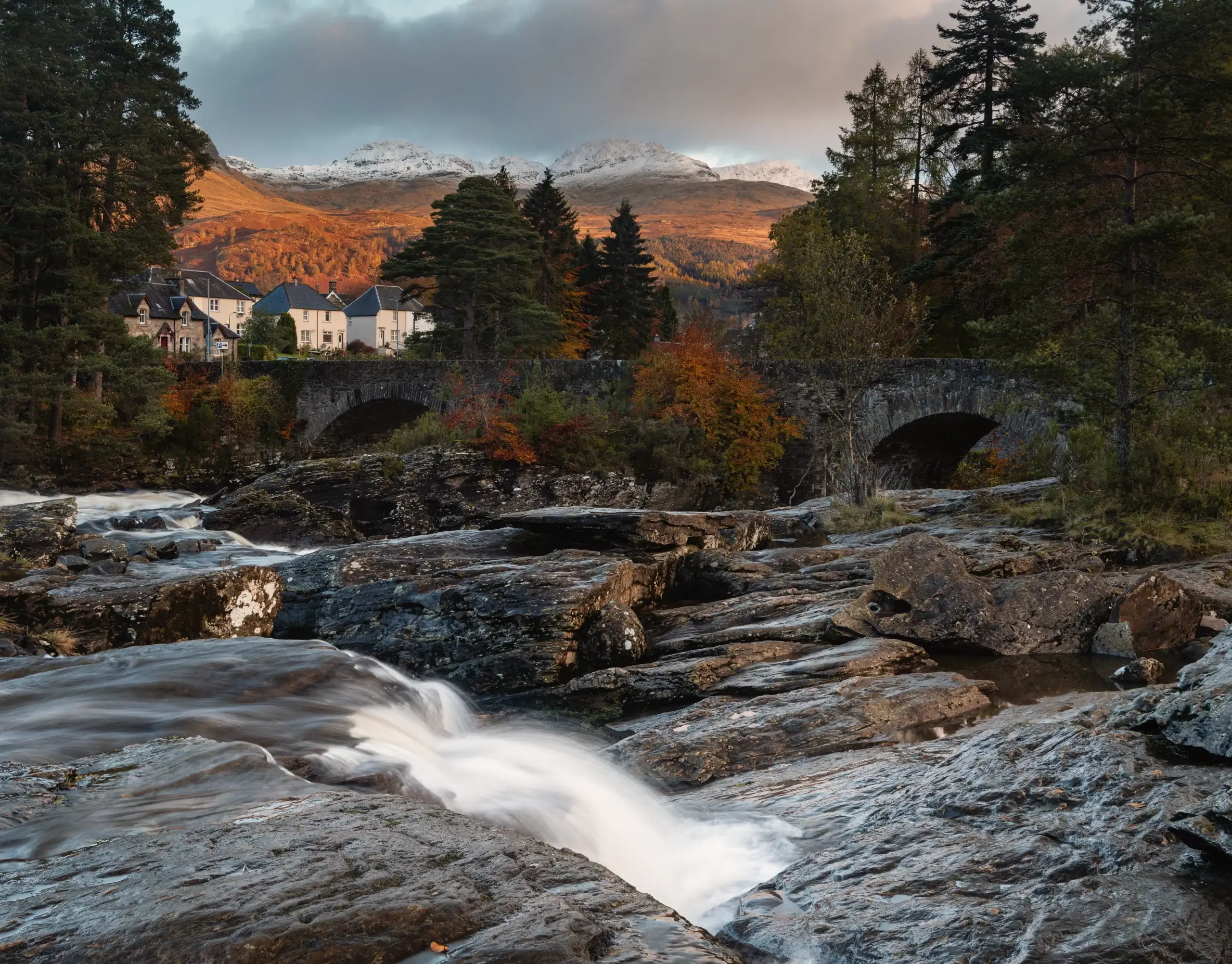
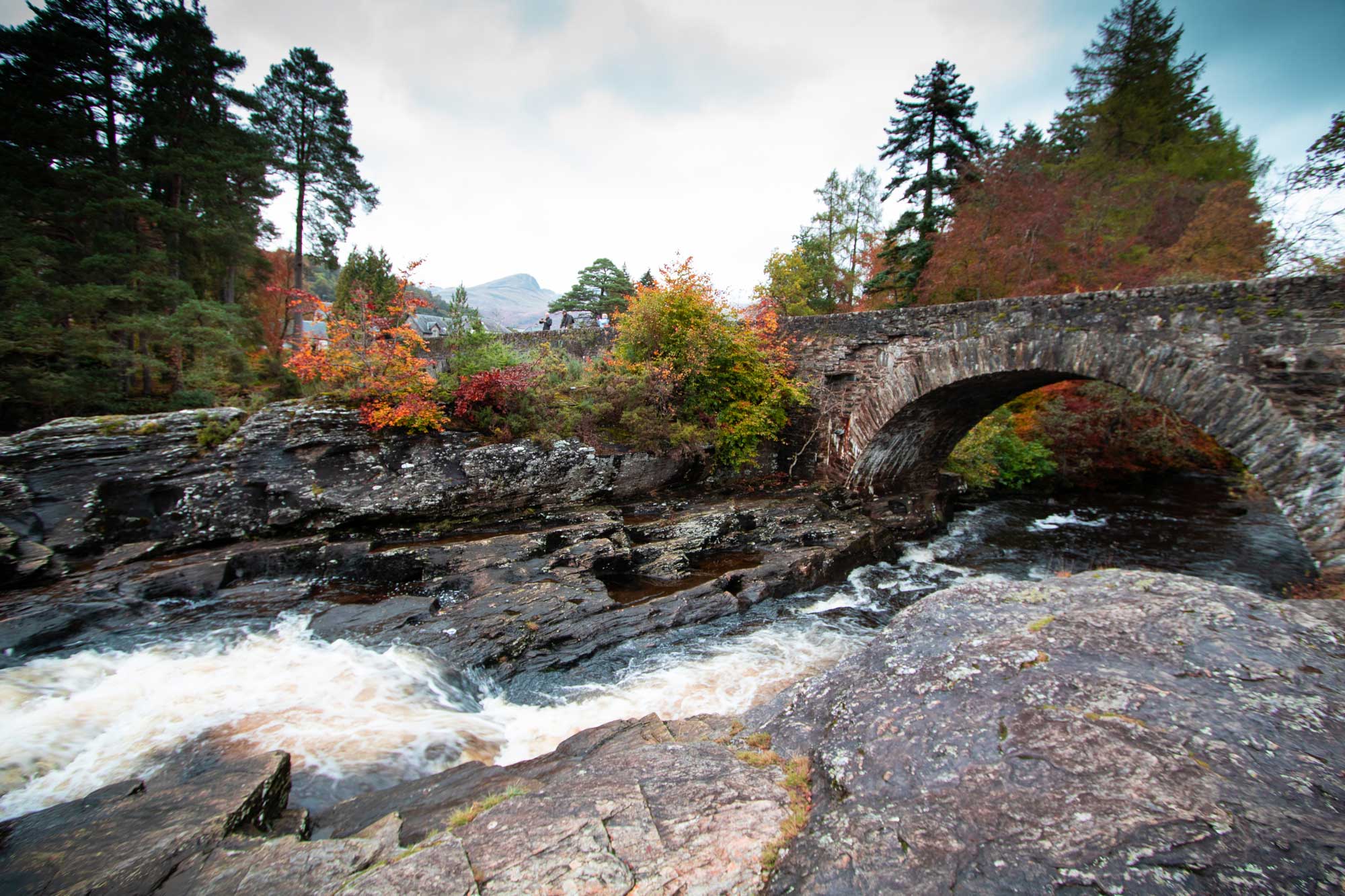
Continue to Killin — one of Perthshire’s most scenic and characterful villages, set at the western end of Loch Tay where the River Dochart rushes over its famous falls in the heart of the village. The Falls of Dochart pour over ancient boulders directly beneath the old stone bridge in the village centre, framed by Ben Lawers and Meall nan Tarmachan rising above. In the middle of the falls sits the tiny island of Inchbuie — the ancient burial ground of Clan MacNab — adding a layer of history and atmosphere to a scene of already remarkable natural beauty.
The day concludes at Deanston Distillery — housed in a converted 18th-century cotton mill on the banks of the River Teith near Doune, one of Scotland’s finest and most underrated Highland single malt distilleries. Its unusual cathedral-like production floor, unpeated honey-rich whisky style, and warm welcome make it a favourite among connoisseurs — and a late-afternoon tasting is the ideal way to reflect on one of the most beautiful and story-rich days of the entire nine.
Approximately 9 hours | Angus, Fife & Edinburgh | Return to Edinburgh
The final day of Scotland’s most comprehensive private tour is a fitting and deeply satisfying conclusion — moving through the storied landscapes of Angus and Fife, arriving in the ancient university town that gave golf to the world, tracing the East Neuk’s string of medieval fishing villages, and returning to Edinburgh across the Forth Bridges as nine extraordinary days draw to their close. Day Nine brings the full arc of Scotland’s story full circle — from a haunted royal castle to the birthplace of the game played in 120 countries — and delivers you home changed by the country you have come to know.
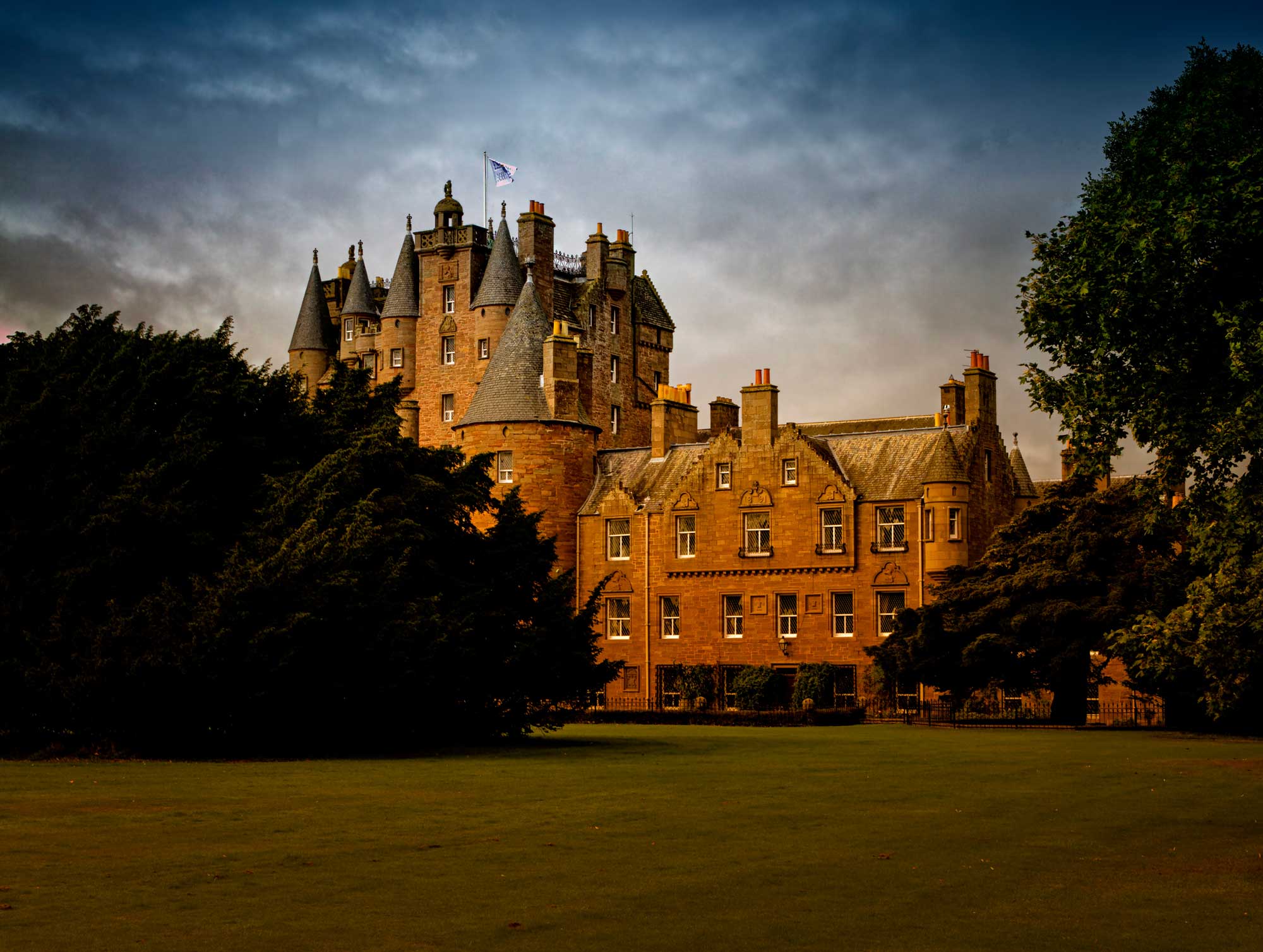
Begin at Glamis Castle — one of the most magnificent and most mysterious castles in Scotland, the ancestral home of the Earls of Strathmore and Kinghorne and the childhood home of Queen Elizabeth The Queen Mother. The birthplace of Princess Margaret in 1930 — the first royal birth in Scotland for three centuries — and the setting for Shakespeare’s Macbeth, Glamis’s extraordinary fairy-tale silhouette of towers, turrets, and chimneys rising above its wooded park is one of the most romantically beautiful in Scotland.
Glamis is also Scotland’s most haunted castle: the legendary Monster of Glamis — a hideously deformed secret heir said to have been concealed in a hidden room for generations — the Grey Lady believed to be the ghost of Lady Janet Douglas, burned as a witch in 1537 on the orders of James V, and the tongueless woman who wanders the grounds. Johnny will tell every story, and some of them will stay with you long after you leave.
Arrive in St Andrews for lunch — a town of extraordinary historical, cultural, and sporting concentration. Scotland’s oldest university, founded in 1413, its ancient quadrangles and cobbled streets reminiscent of Oxford and Cambridge. The ruined 12th-century Cathedral — once the largest church in Scotland — and the clifftop Castle with its notorious bottle dungeon carved from solid rock speak to the town’s medieval ecclesiastical power. And then there is golf.
The Old Course at St Andrews is the oldest and most venerated golf course in the world — where the game has been played continuously since the 15th century on a narrow strip of common land between the town and the North Sea. Stand on the Swilcan Bridge — crossed by Tiger Woods, Jack Nicklaus, Arnold Palmer, and every great champion of the modern era — and understand why golfers travel from every corner of the world to pay their respects here. The R&A Clubhouse, overlooking the 18th green, is one of the most recognisable buildings in world sport.
Travel south along the Fife Coastal Route through the East Neuk — a succession of perfectly preserved medieval fishing villages whose harbours, cobbled streets, and painted cottages have barely changed in centuries. Anstruther, with the finest fish and chips in Scotland and the outstanding Scottish Fisheries Museum. Pittenweem, with its still-active lobster boats on the quayside. St Monans, its ancient church so close to the sea the tides once lapped its walls. Crail — perhaps the most photographed village on the Fife coast, its honey-coloured stone harbour one of the most painted scenes in Scottish art.
The final miles bring you back to South Queensferry and the three Forth crossings — seen now through the lens of nine extraordinary days and a journey of nearly two thousand miles. The Forth Rail Bridge, glowing in the late afternoon light, marks the boundary between the Highlands and the Central Belt — and crossing it for the second time on this journey carries a weight that the first crossing, nine days and a lifetime of memories ago, could not have done. Scotland has been experienced. Its landscapes, history, and stories are no longer abstractions. They are part of you now.
Arrive back in Edinburgh — where it all began, nine days and a complete understanding of Scotland ago. Johnny will answer any final questions, share recommendations for the rest of your time in Scotland, and ensure your seamless drop-off at your Edinburgh accommodation. Nine days. Every great story. One extraordinary country — completely and properly known.
Ready to experience the very best of Scotland on your own terms? Tell us when you’d like to travel, how many are in your party, and where you’d like your journey to begin. We’ll check availability for your preferred dates and craft a bespoke multi-day itinerary shaped around your interests, pace, and must‑see places. Share a few details below and our expert driver‑guide will be in touch with a personalised proposal, pricing, and suggestions to make your time in Scotland unforgettable.
Max 6 persons
Max 5 suitcases
We look forward to welcoming you to Scotland — personally.