The Queen of the Hebrides
4-Day Private Islay Whisky Tour from Edinburgh, Glasgow or Stirling
Max 6 persons
Max 5 suitcases
Prices from £650 per day for a group of six persons. T&Cs apply.
Travelling with a larger group? Get in touch4-Day Private Islay Whisky Tour from Edinburgh, Glasgow or Stirling
Max 6 persons
Max 5 suitcases
Prices from £650 per day for a group of six persons. T&Cs apply.
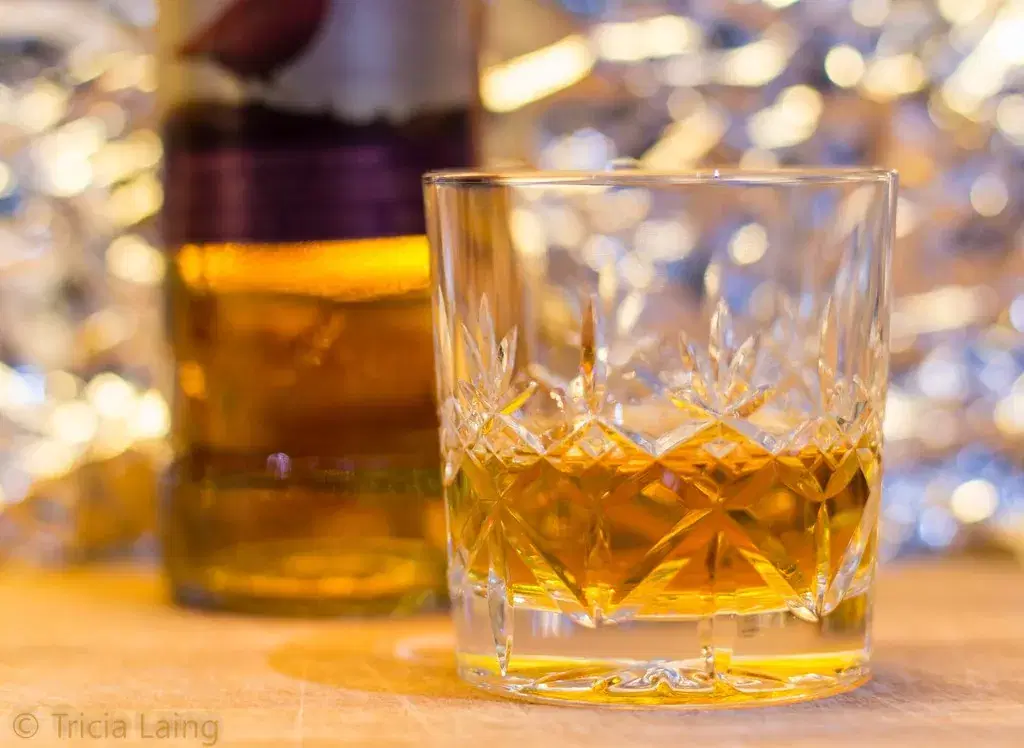
Travelling with a larger group? Get in touchThere are whisky islands and there is Islay. Known as the Queen of the Hebrides, this small island off the Kintyre Peninsula produces more world-famous single malt Scotch whisky per square mile than anywhere else on earth — nine working distilleries, each producing a spirit of distinct character shaped by the same Atlantic peat, the same coastal winds, and the same dark island water, yet differing from one another in ways that take a lifetime of study to fully appreciate. Laphroaig, Lagavulin, Ardbeg, Bruichladdich, Bowmore, Bunnahabhain, Caol Ila, Kilchurn, Ardnahoe — names that appear on the shelves of the finest bars in New York, Tokyo, and Sydney, each representing a different expression of an island that has been making whisky for at least five centuries.
This four-day private tour is designed for the guest who wants to experience Islay properly — not as a day trip from the mainland or a rushed distillery crawl, but with two full days on the island, time to understand what makes each expression distinct, and the context of the remarkable landscape, history, and culture that shapes every dram poured here. The journey to and from Islay is itself part of the experience: the prehistoric monuments of Kilmartin Glen, the oldest distillery in the west at Oban, the ancient seat of the Lords of the Isles at Finlaggan, the longest sea loch in Scotland, and Inveraray Castle on the return.
Every mile is guided by Johnny Dreczkowski MBE — honoured by His Majesty The King in June 2025, a proud Scot and professional driver-guide renowned for his storytelling, heritage knowledge, and warm Scottish hospitality — from the seamless comfort of your private new Mercedes V-Class Avantgarde. This tour departs from Edinburgh, Glasgow, or Stirling — whichever suits you best. The whisky of Islay is waiting.
🏰 Day One — To the West Coast: Kilchurn, Oban & the First Dram
Approximately 4–5 hours driving | Edinburgh, Glasgow or Stirling to Oban | Overnight: Oban (Night 1)
The journey west begins with a choice of starting points — Edinburgh, Glasgow, or Stirling — and converges on the same road as it crosses into Argyll and the landscape opens into the broad, dramatic country of the western Highlands. Day One is a day of arrival and anticipation: the first Highland castle, the first distillery, the first dram of the tour. By the time you check into your Oban hotel with the sound of the harbour below and the islands visible on the horizon, the island of Islay is already close enough to feel.
🌉 Departing Edinburgh, Glasgow or Stirling
Johnny will collect you seamlessly from your accommodation in Edinburgh, Glasgow, or Stirling and head west — each departure point offering a slightly different view of Scotland’s central belt before the landscape transitions dramatically into the Highland country of Argyll. From Edinburgh the route passes the three Forth crossings and Stirling; from Glasgow it follows the Clyde valley west before turning north; from Stirling the road rises immediately into the hills above the Highland Boundary Fault. All three routes converge at Loch Awe — and all three deliver you into one of the most beautiful landscapes in Scotland.
🏰 Kilchurn Castle – The Jewel of Loch Awe
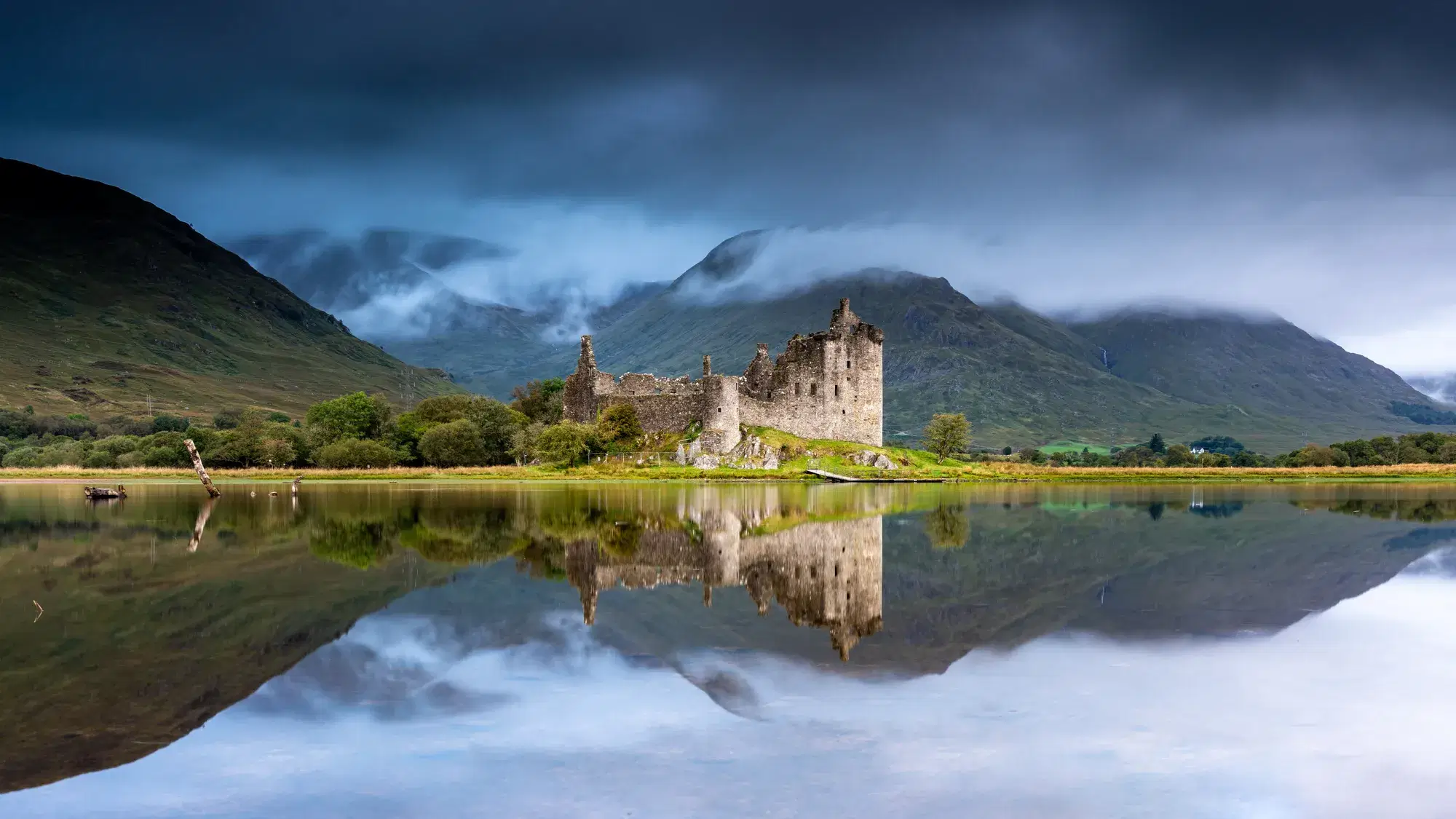
Stop at Kilchurn Castle at the head of Loch Awe — a 15th-century Campbell fortress rising from a rocky promontory at the water’s edge, its towers and curtain walls reflected in the dark stillness of the loch with the peak of Ben Cruachan soaring behind. One of the most romantically ruined and most photographed castles in Scotland, Kilchurn was built in 1450 by Sir Colin Campbell, gradually abandoned from the late 17th century, and partially demolished by a lightning strike that left its remaining towers in the state of picturesque perfection that has made it the subject of painters and poets since the Romantic era. Turner painted it. Wordsworth wrote about it.
The view from the lochside — castle reflection breaking in the ripples, mountains behind, the loch stretching south between forested hillsides — is one of those Scottish landscape moments that stops conversation entirely. It is also the perfect introduction to the Argyll coast that carries you west to Oban: a reminder that this journey to a whisky island passes through some of the most beautiful country in Scotland.
🥃 Oban Distillery – The First Dram of the Tour
Arrive in Oban — the irresistible gateway to the Hebridean Islands, where CalMac ferries depart for Mull, Islay, Colonsay, and the Outer Hebrides and the town’s position at the junction of the island routes has made it the most important port on the west coast for two centuries. The distillery sits in the heart of the town, its pagoda roofs visible from the harbour, established in 1794 and operating continuously for over 230 years in one of the most constrained and most atmospheric distillery settings in Scotland.
Oban single malt — lightly peated, maritime, with notes of sea salt, heather honey, and dried fruit — is the definitive west Highland coastal whisky: the westernmost expression of the Highland style, already pointing towards the more emphatic peat and brine of the islands ahead. A guided tour of the production floor, with its small stills and centuries-old layout barely changed since the 19th century, and a tasting overlooking the bay is the ideal way to calibrate the palate for what Islay is about to deliver.
🦞 Overnight in Oban – Scotland’s Seafood Capital
Check into your Oban hotel as the evening light settles over the bay and McCaig’s Victorian folly glows above the town on its hill. Oban’s position at the junction of the Hebridean ferry routes makes it the distribution point for the finest shellfish in Scotland — langoustines, scallops, oysters, crab, and lobster landed at the pier and served within hours in the town’s excellent restaurants. Johnny will share his personal recommendations for the evening — the Waterfront Restaurant, the Ee-Usk seafood bar, and the harbour shellfish stall are all exceptional depending on the occasion and the appetite. Sleep well. Tomorrow the ferry takes you to Islay.
⛵ Day Two — Islay Bound: Kilmartin Glen, the Ferry & the Southern Trinity
Approximately 10 hours including ferry | Oban to Islay via Kilmartin Glen & Kennacraig | Overnight: Islay (Night 2)
Day Two is the great transition day — from the Scottish mainland to the island that has been the destination since the tour began. The road south from Oban passes through Kilmartin Glen, one of the most important prehistoric landscapes in Europe, before reaching Kennacraig on the Kintyre Peninsula for the two-hour CalMac crossing to Islay. On arrival, the southern coast of the island reveals its most famous distilleries in quick succession — the trio that has defined the Islay style for the world. The evening on Islay, the smell of peat smoke in the air, the sound of the Atlantic beyond the headlands, is unlike anything available anywhere else.
🪨 Kilmartin Glen – 5,000 Years of Scottish Prehistory
Travel south from Oban through the Kilmartin Valley — one of the most extraordinary prehistoric landscapes in Europe, containing over 800 ancient monuments within a six-mile radius: Neolithic and Bronze Age burial cairns arranged in Scotland’s longest linear cemetery, standing stones, stone circles, and some of the most elaborate cup-and-ring rock carvings in the world, their meaning still not fully understood after 150 years of archaeological study. The concentration of monuments here surpasses almost anywhere else in Britain outside Orkney — and unlike the more famous sites, Kilmartin is visited by relatively few travellers, giving the experience a quality of solitary communion with the ancient past that larger sites cannot offer.
Kilmartin Museum — recently rebuilt and now one of the finest archaeological museums in Scotland — provides the context that brings the landscape alive. The journey from this prehistoric glen to the ferry at Kennacraig is itself a gradual revelation of the Kintyre Peninsula’s quiet, unhurried beauty — single-track roads, Atlantic views, and the sense of approaching somewhere genuinely remote.
⛵ Kennacraig to Islay – Two Hours on the Hebridean Sea
Board the CalMac ferry at Kennacraig for the two-hour crossing to Islay — one of the finest short sea passages in Scotland, the mainland coastline and the hills of Kintyre receding behind as the islands of Gigha, Jura, and finally Islay itself rise ahead. The crossing passes between Jura’s distinctive Paps — three quartzite peaks rising to over 750 metres above the Sound of Islay — and gives the first long views of the island whose whisky has brought you here. Harbour porpoises, common dolphins, and grey seals are regular companions in the Sound; in summer, minke whales are occasionally sighted.
The ferry serves Port Ellen on the southern coast or Port Askaig on the northeastern shore — arrival point varies by sailing. Port Ellen, flanked by the three great southern distilleries within a mile of the pier, announces its whisky character immediately. Port Askaig, set in a wooded cleft above the narrows of the Sound of Islay, is smaller and quieter, with Jura directly across the water close enough to shout across. Either arrival is a moment of genuine arrival — the island has its own atmosphere, its own pace, and its own smell.
🥃 Laphroaig – Peat, Sea & Royal Warrant
Drive to the southern coast of Islay and the trio of distilleries that have defined the island’s reputation worldwide. Begin at Laphroaig — arguably the most famous and most polarising single malt in Scotland, a whisky of such emphatic peat smoke, iodine, and medicinal intensity that its admirers are fanatical and its detractors are equally passionate. Founded in 1815 on the shores of Loch Laphroaig, the distillery holds a Royal Warrant from King Charles III — who, as Prince of Wales, visited in 1994 and is said to have declared it his favourite dram.
Laphroaig is one of the last distilleries in Scotland to maintain its own floor maltings — a rare and labour-intensive process in which barley is spread on a stone floor and turned by hand over several days as it germinates, then dried over an Islay peat fire whose smoke gives the malt its characteristic flavour. A tour of the maltings, the still house, and the warehouses stacked with maturing casks breathing the salt air of the bay is an education in the craft of whisky-making at its most elemental. The tasting that follows — the 10-year expression, the Quarter Cask, perhaps a cask-strength bottling — is the tour’s first full immersion in the Islay style.
🥃 Lagavulin – Complexity Above the Bay
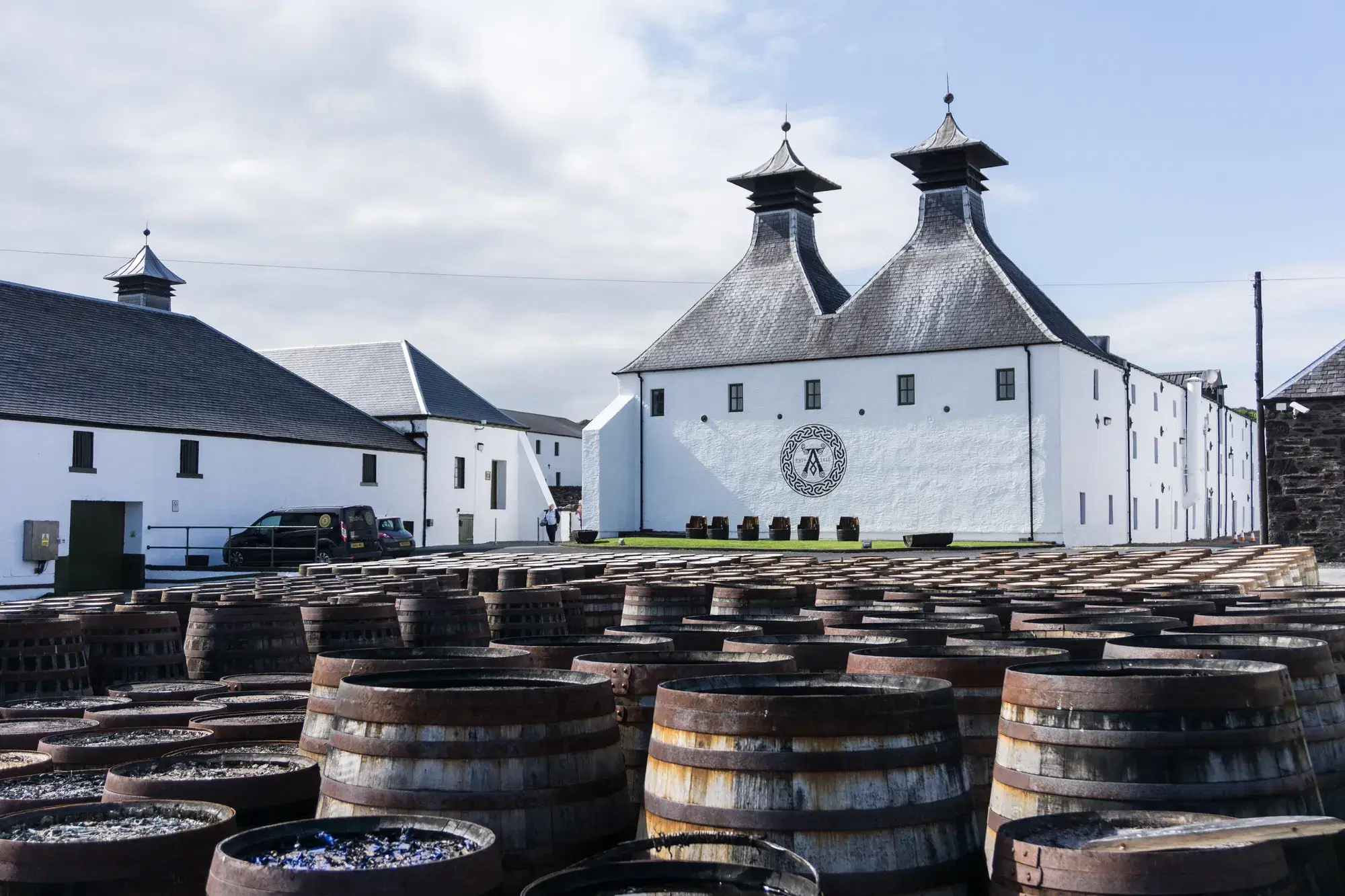
Continue a mile east along the coastal road to Lagavulin — whose distillery sits above a sheltered bay of exceptional beauty, its white-harled buildings reflected in the still water as the ruins of Dunyvaig Castle, once the naval base of the Lords of the Isles, stand on the headland above. Lagavulin produces one of the most complex and most celebrated single malts in Scotland: the 16-year expression in its distinctive square bottle is the benchmark against which all heavily peated whiskies are measured — smoky and medicinal like Laphroaig, but with a depth of dried fruit, dark chocolate, and sherry-cask richness that speaks of long maturation and careful cask selection. A private tasting at Lagavulin — exploring the character differences between expressions aged in different cask types — is a masterclass in how the same peated spirit transforms over time.
🥃 Ardbeg – The Cult Distillery
Complete the southern trinity at Ardbeg — the most heavily peated of the three and the distillery with perhaps the most devoted international following of any whisky producer in the world. Closed from 1981 to 1989 and again from 1996 to 1997, Ardbeg was rescued and revived by Glenmorangie in 1997, and the cult following it has accumulated since its return to full production has made its annual Islay Festival releases some of the most anticipated and most collectible whisky bottlings on the planet. The Old Kiln Café at Ardbeg serves outstanding food made from Islay produce — an excellent dinner option after the afternoon’s tastings — and the distillery shop, with its range of core and limited expressions, offers some of the best whisky retail on the island.
🌊 Day Three — Islay Explored: The Island, its History & its Remaining Distilleries
Full day on Islay | Overnight: Islay (Night 3)
The second and final full day on Islay moves beyond the southern trinity to explore the full breadth of the island — its prehistoric and medieval history, its Atlantic coastline, its wildlife, and the four remaining working distilleries that complete the island’s whisky picture. By the end of Day Three the Islay single malt will no longer be simply a drink but a landscape, a culture, and a community — bottled.
🏛️ Finlaggan – The Ancient Seat of the Lords of the Isles
Begin the morning at Finlaggan — one of the most historically significant and most atmospherically compelling sites in the Scottish islands, and one that the majority of Islay visitors never discover. Set on two small islands in Loch Finlaggan in the heart of the island, the ruined great hall, chapel, and council chamber of the Lords of the Isles — the most powerful Gaelic dynasty in medieval Scotland and Ireland, who ruled the Hebrides and much of western Scotland as a virtually independent kingdom from the 12th to the 15th century — are accessible by a short wooden causeway across the loch.
The Lords of the Isles held court at Finlaggan in a style that combined the Gaelic traditions of Ireland with the Norse heritage of the Viking settlers who had preceded them, presiding over a Hebridean cultural renaissance that produced extraordinary illuminated manuscripts, carved stone monuments, and a tradition of bardic poetry that survived the destruction of their power by the Scottish Crown in 1493. For American guests with Scottish or Irish Gaelic heritage, Finlaggan is one of the most resonant sites on the entire tour — the physical remains of the world their ancestors came from, set in a landscape of quiet, reedy beauty that has changed little in five centuries.
🌊 The Atlantic Shore – Saligo Bay & the Oa Peninsula
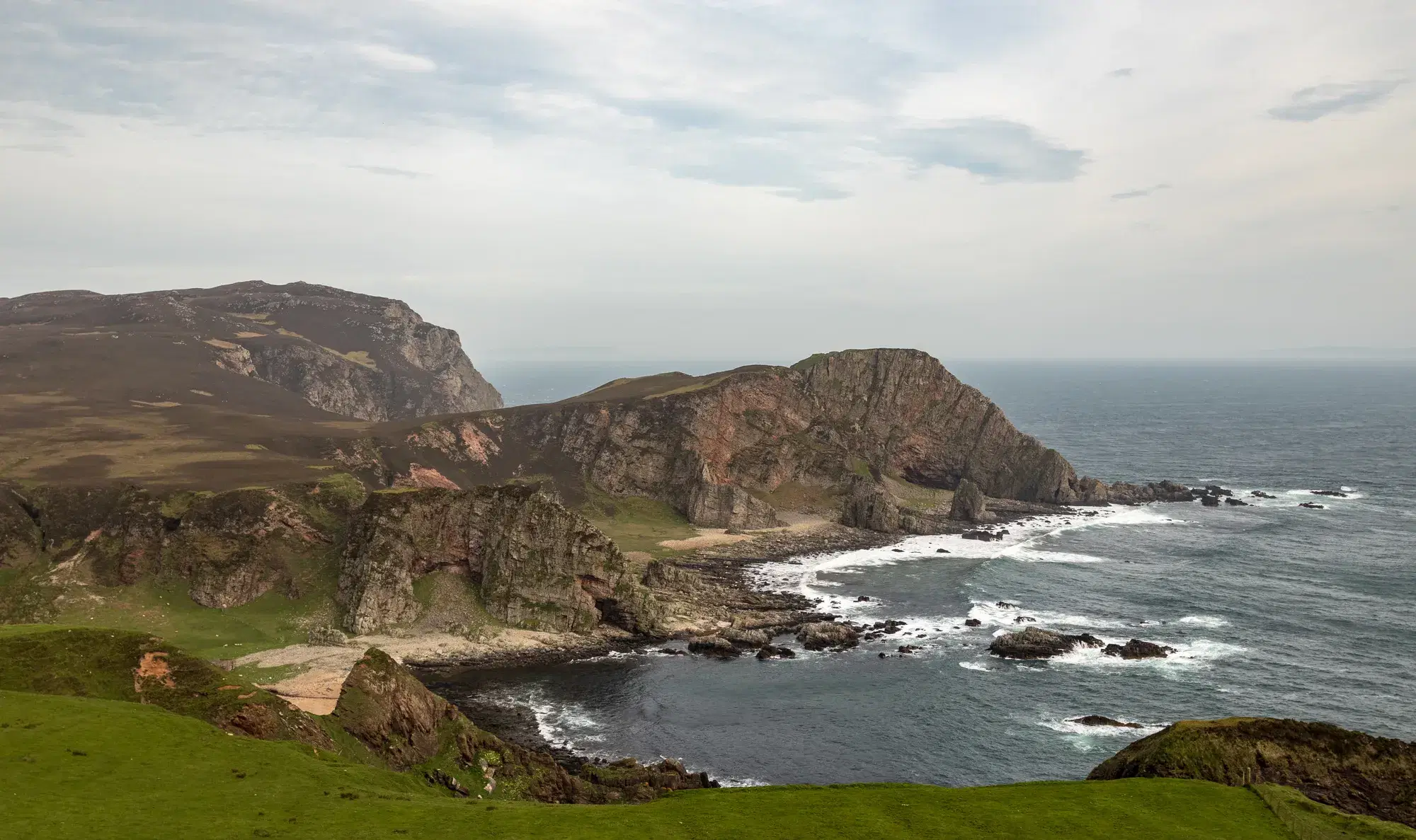
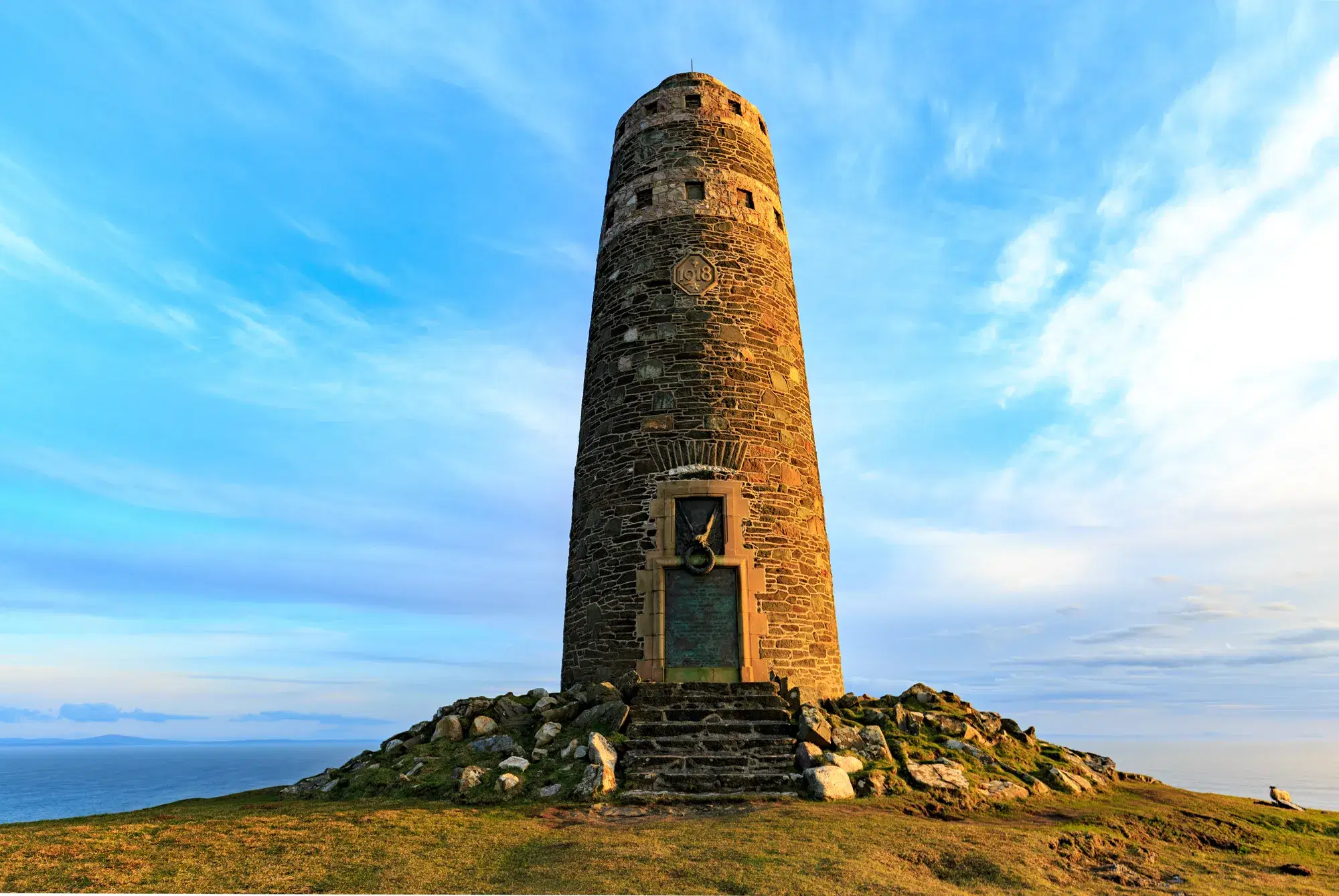
Drive to the western and southern shores of Islay — where the Atlantic arrives without interruption from Newfoundland and the coastline responds with beaches, cliffs, and headlands of exceptional drama. Saligo Bay on the northwest coast is one of the most beautiful beaches in the Hebrides: a broad sweep of white shell sand backed by machair grassland and marram dunes, with the Atlantic rolling in from the open ocean in long, unbroken swells. The Oa Peninsula in the south offers the island’s most dramatic cliff scenery and the American Monument — a lighthouse-style memorial erected by the American Red Cross in 1920 to commemorate the 700 American servicemen who died in the wrecks of the SS Tuscania and HMS Otranto off the Islay coast in 1918. Golden eagles nest on the Oa; hen harriers and choughs are regularly visible; the grey seals hauled out on the rocks below the cliffs are a permanent presence.
🥃 Bowmore – The Heart of the Island
Continue to Bowmore — Islay’s principal village and the site of its oldest licensed distillery, established in 1779 on the shore of Loch Indaal in a position that, characteristically for Islay, gives the warehouses direct exposure to the salt air of the loch. Bowmore single malt occupies a middle position in the Islay flavour spectrum — more heavily peated than Bunnahabhain or Bruichladdich, less intensely smoky than Laphroaig or Ardbeg — a balance of peat, fruit, and honey that has made it the accessible face of Islay whisky for generations of drinkers approaching the island style for the first time. The distillery’s Number One Vaults warehouse, built partially below the high-tide line, is one of the most evocative maturation environments in Scotland.
🥃 Bruichladdich – Progressive Hebridean Distillery
Drive to the western shore of Loch Indaal and Bruichladdich — the most unconventional and most philosophically interesting distillery on Islay, re-established in 2001 after a period of closure by a group of independent whisky enthusiasts determined to make spirit that challenged the conventions of the industry. Bruichladdich produces three distinct expressions: the unpeated, terroir-focused Bruichladdich; the moderately peated Port Charlotte; and Octomore — the most heavily peated whisky commercially produced anywhere in the world, typically exceeding 200 parts per million of phenol compared to Laphroaig’s 45. A tasting that moves through all three expressions across the peat spectrum is one of the most educationally illuminating whisky experiences available on the island.
🥃 Bunnahabhain & Caol Ila – The Northern Pair
Continue north along the eastern coast of Islay to the two great northern distilleries. Bunnahabhain — founded in 1881 in a remote bay at the northern tip of the island, accessible only by a single-track road — produces an unpeated or lightly peated Islay malt of unusual elegance and approachability, its nutty, maritime character shaped by the Sound of Islay that laps at the distillery wall. The setting alone justifies the drive: the distillery cottages clustered above the bay, Jura’s Paps directly across the water, and a quality of isolation that makes the tasting room feel like the edge of the known world.
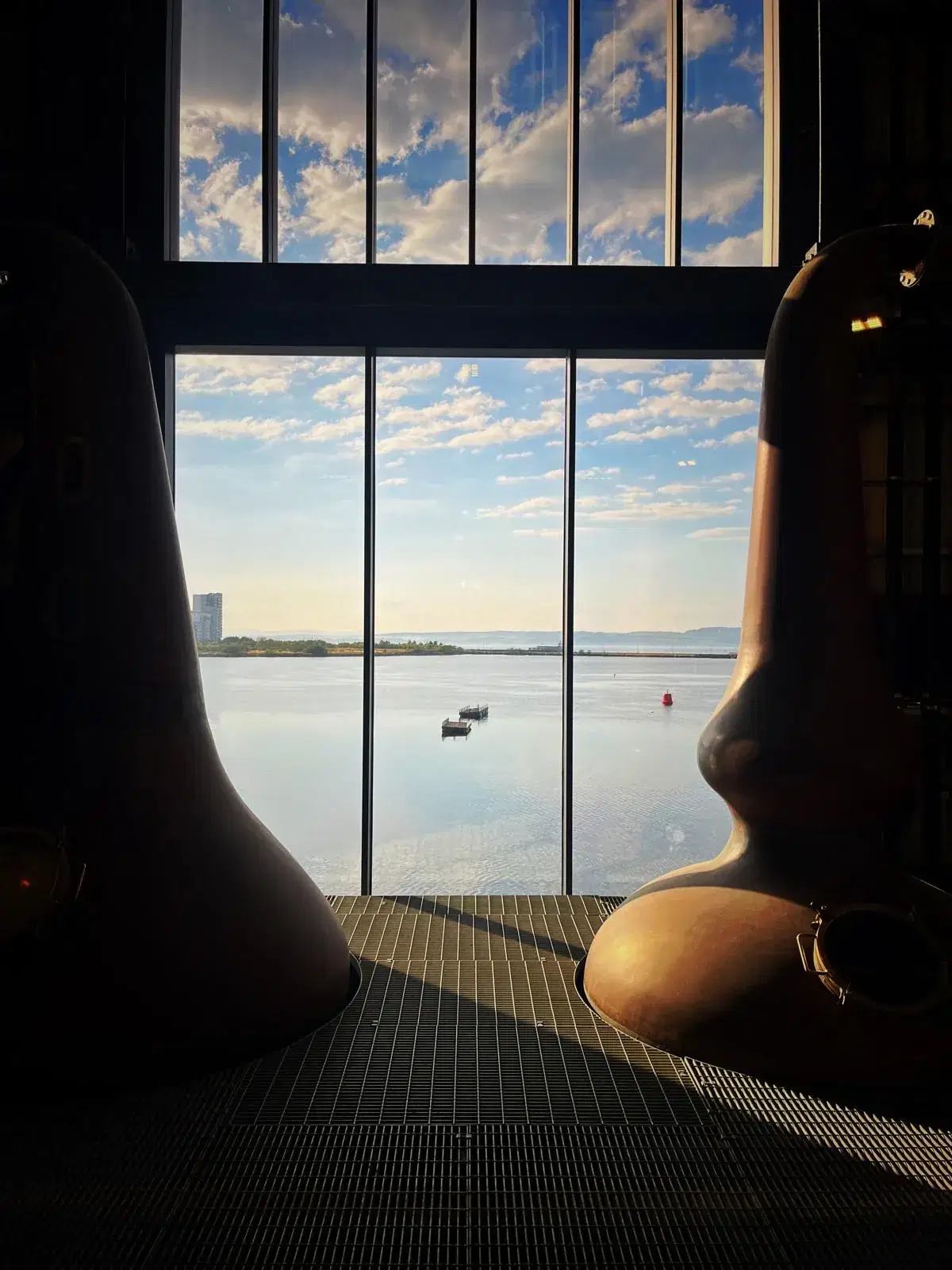
Caol Ila — the largest distillery on Islay by production volume, producing around 6.5 million litres of spirit per annum — sits in a dramatic position above the Sound of Islay with floor-to-ceiling windows looking directly across to Jura. Long known primarily as a blending malt underpinning many of Diageo’s major blended Scotch brands, Caol Ila has developed its single malt range significantly in recent years, and the new visitor experience — taste-led, with a tasting flight designed to explore the distillery’s full range of expressions from lightly peated to heavily smoky — is among the most informative and most generously appointed on the island.
🦞 Day Four — Back to the Mainland: Inveraray, Loch Fyne & Loch Lomond
Approximately 8–9 hours | Islay ferry to Edinburgh, Glasgow or Stirling via Inveraray & Loch Lomond | Return to starting point
The final day crosses back to the mainland and travels south through Argyll in a series of stops that bring the tour to a satisfying conclusion — the finest food on Loch Fyne, the grandest castle in Argyll, and the most famous loch in Scotland before the return to Edinburgh, Glasgow, or Stirling. The whisky is in the bag. The scenery on the way home is considerable.
⛵ The Crossing Back – Islay to Kennacraig
Board the morning CalMac ferry from Islay back to Kennacraig — the same Sound of Islay, the same Paps of Jura, the same mainland coastline arriving as the island recedes. The return crossing has a different quality from the outward journey: the island is now known, its distilleries visited, its landscape explored. The whisky bottles carefully wrapped in the luggage lend the crossing a particular satisfaction.
🥃 Loch Fyne Whisky – The Connoisseur’s Shop
Drive north along the shore of Loch Fyne — at 65 kilometres the longest sea loch in Scotland, its dark water filling a glacial valley between forested hillsides in a composition of sustained, moody beauty — to Inveraray and the Loch Fyne Whisky shop. One of the most respected independent whisky retailers in Scotland, Loch Fyne Whisky stocks an outstanding range of single malts, blended Scotch, and small-batch bottlings that is particularly strong on Islay expressions — the ideal final opportunity to add to the tour’s collection with the advice of specialists who know the island’s distilleries intimately.
🏰 Inveraray Castle – Eight Centuries of Clan Campbell
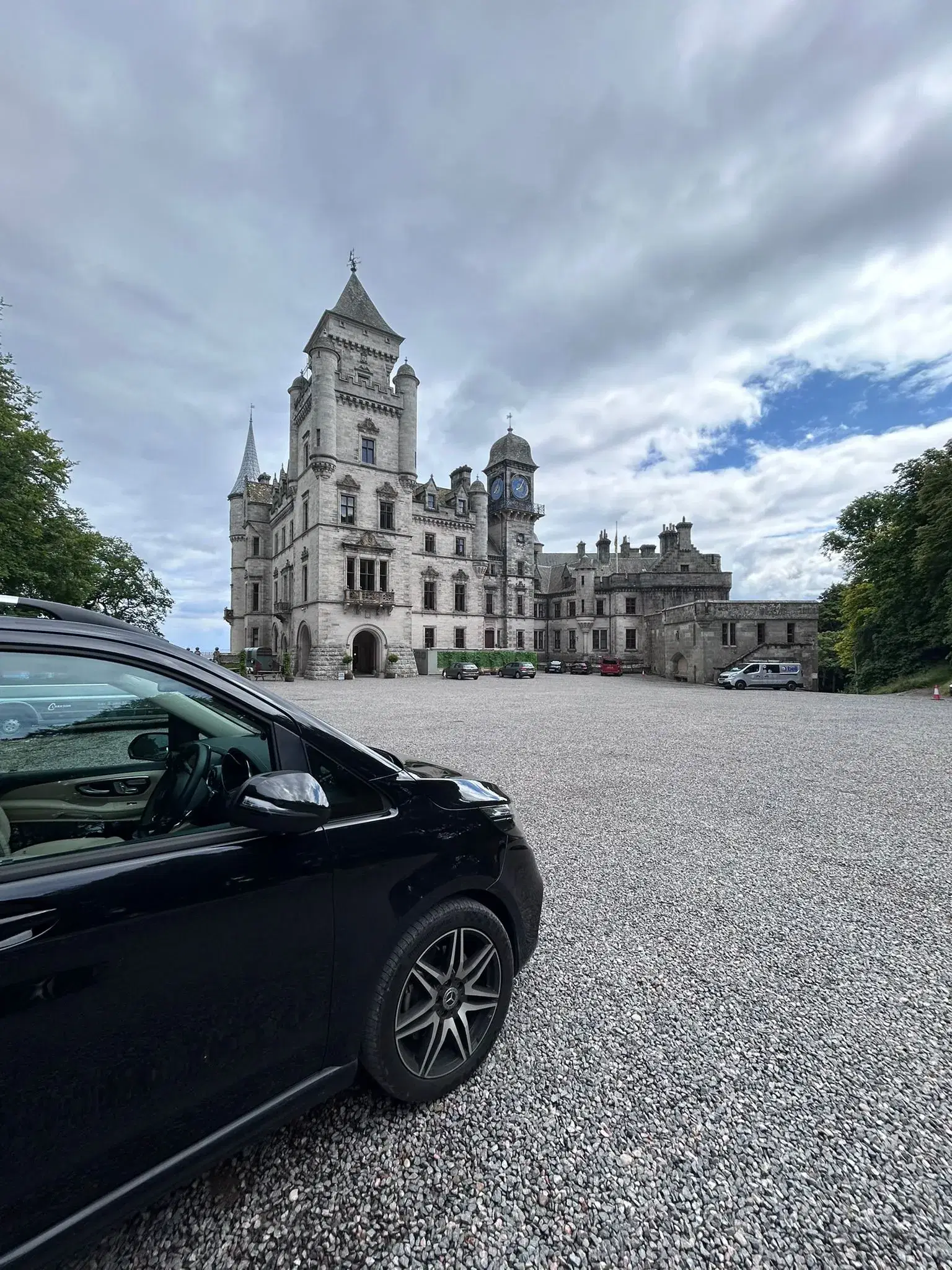
Continue to Inveraray Castle — the ancestral home of the Dukes of Argyll and the Chiefs of Clan Campbell, whose Gothic Revival exterior with its four corner towers and distinctive central conical spire is one of the most immediately recognisable castle facades in Scotland. The State Rooms are among the finest in the country: the Armoury Hall, whose walls are covered in muskets, broadswords, pikes, and axes arranged in elaborate geometric patterns, is extraordinary; the Tapestry Drawing Room and State Dining Room, prepared for Queen Victoria’s visit of 1877, are magnificent. The castle has served as a filming location for Downton Abbey and Outlander, and the gardens and grounds — with their views across the formal parkland to the loch — are among the finest in Argyll.
🦞 Lunch at the Loch Fyne Oyster Bar
Lunch at the Loch Fyne Oyster Bar at Cairndow — the original and still the finest of the Loch Fyne restaurants, set in a converted farm building at the head of the loch where the River Fyne meets the sea. The Loch Fyne oysters — among the most celebrated in Britain, farmed in the cold, clean water of the loch and served still tasting of the sea — are the centrepiece of a menu that extends to smoked salmon, langoustines, crab, and the full range of Scottish west coast shellfish. A glass of crisp Chablis or a late-morning dram of Islay single malt with the oysters is, in Johnny’s considered view, one of the finest combinations in Scottish food and drink.
🌊 The Rest and Be Thankful – Over the Pass
Continue south on the A83 over the dramatic mountain pass of the Rest and Be Thankful — named by the soldiers who built the military road here in 1748 in the aftermath of Culloden, and who rested at the summit with evident feeling after the climb. The viewpoint at the top looks back down Glen Croe in a panorama of considerable Highland drama, and forward to the descent towards Loch Long and the final miles south.
🏔️ Loch Lomond & Luss – A Final Highland Moment
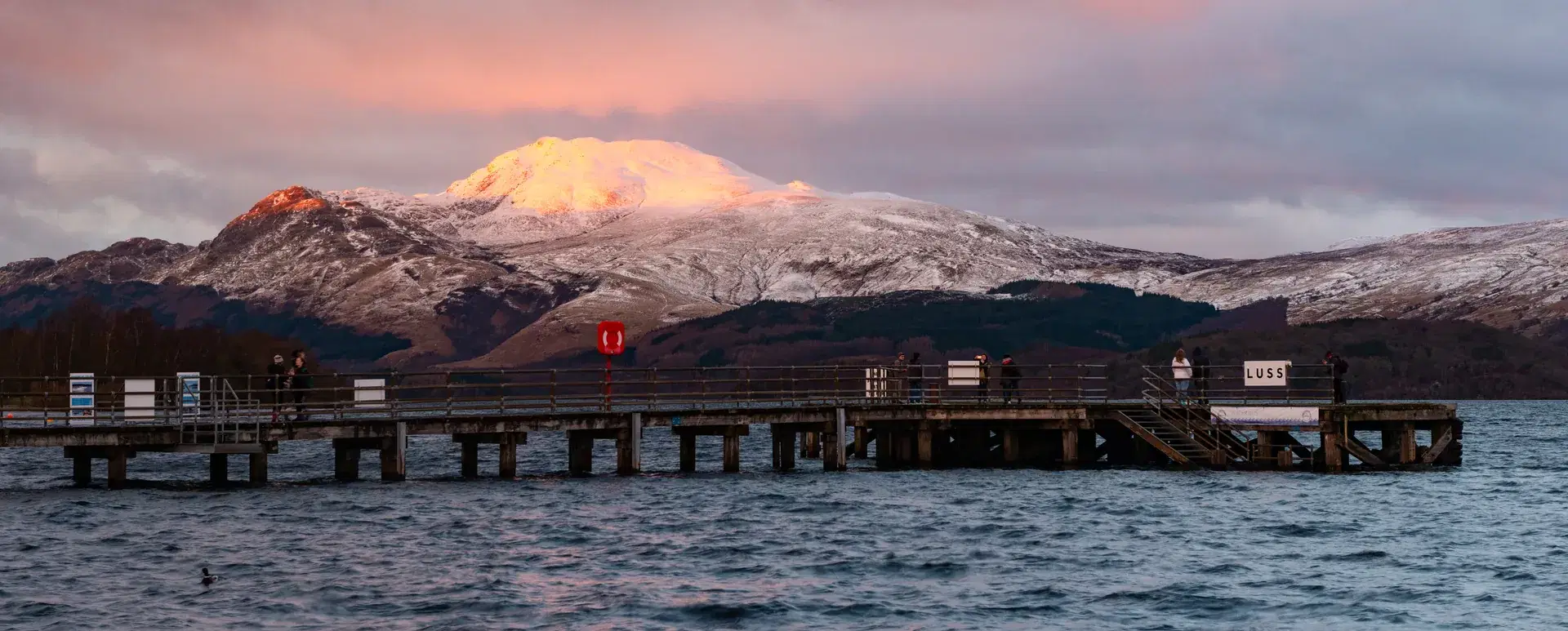
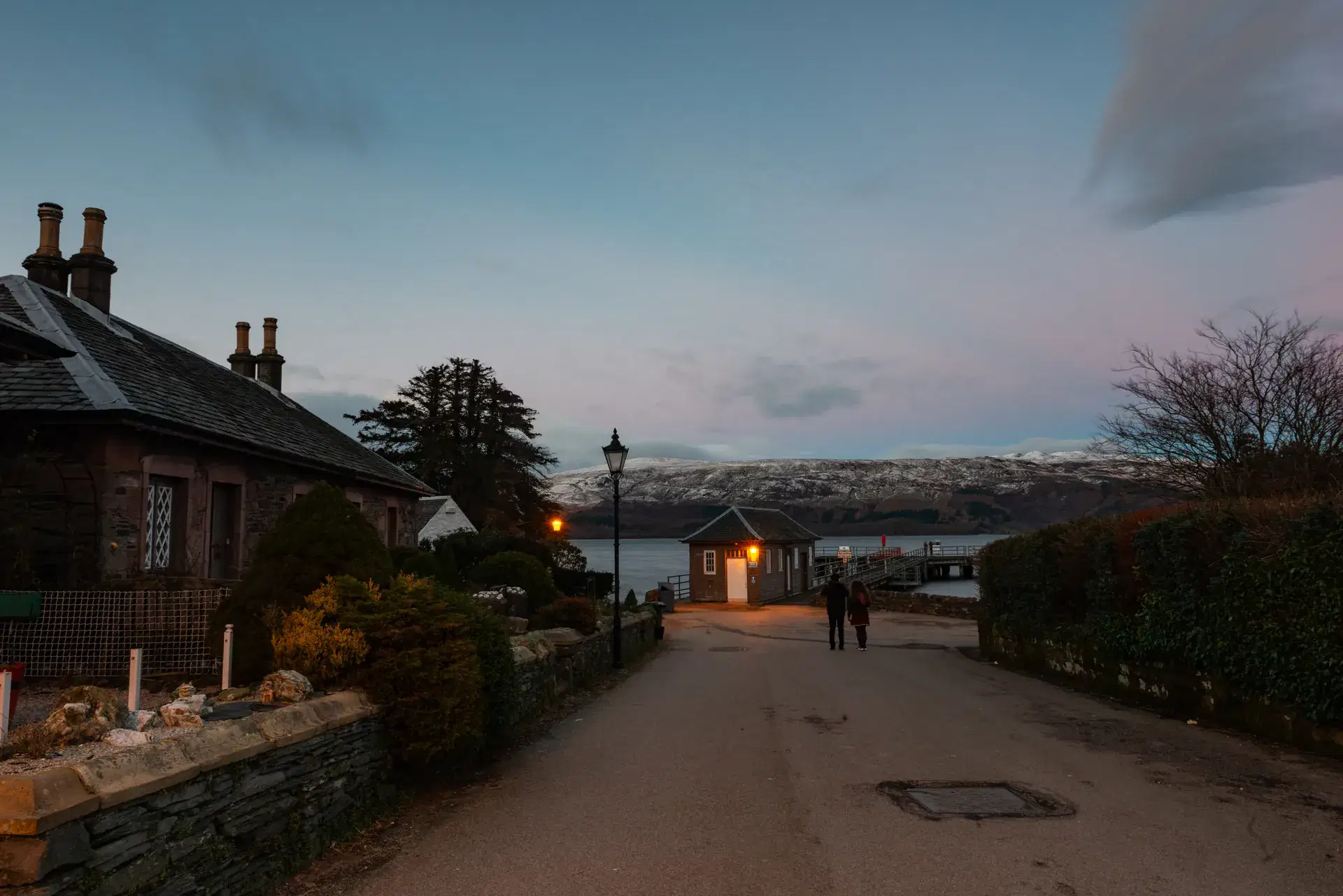
Descend to Loch Lomond — the largest freshwater loch in Britain by surface area, its southern shores suburban and accessible, its northern reaches rising into genuine Highland country above Tarbet and Ardlui. Stop at Luss on the western bank — a conservation village of distinctive stone cottages arranged along a burn running down to the loch shore, with Ben Lomond rising across the water in one of the most composed and most photographed Highland lake views in Scotland. Luss is the perfect final pause of the tour: a coffee, a walk along the shore, a last look at the mountains before the road turns south and Edinburgh, Glasgow, or Stirling calls you home.
🏴 Return to Your Starting Point – Journey’s End
The final miles carry you south through the Loch Lomond and Trossachs National Park and back towards the central belt — Stirling Castle and the Wallace Monument visible on the horizon as the Highland country gives way to the Carse of Stirling, and the familiar skylines of Edinburgh or Glasgow ahead. Johnny will ensure your seamless drop-off at your accommodation, answer any final questions, and share recommendations for any remaining time in Scotland. Four days. One island. Nine distilleries. The Queen of the Hebrides — properly explored.
Ready to experience the very best of Scotland on your own terms? Tell us when you’d like to travel, how many are in your party, and where you’d like your journey to begin. We’ll check availability for your preferred dates and craft a bespoke multi-day itinerary shaped around your interests, pace, and must‑see places. Share a few details below and our expert driver‑guide will be in touch with a personalised proposal, pricing, and suggestions to make your time in Scotland unforgettable.
Max 6 persons
Max 5 suitcases
We look forward to welcoming you to Scotland — personally.